Petrochemical Plants Under CCTS: 11 Units, One Uniform Cut
All 11 petrochemical plants under CCTS must cut intensity by 3.55%. Plant-by-plant tonnes, Reliance's share, and why the cleanest plant isn't the smallest.
Gazette G.S.R. 25(E) of 13 January 2026 gives every one of India's 11 petrochemical plants the same task: cut emission intensity by 3.55% by FY2026-27. Same percentage, very different tonnes.
The Leaderboard: Required Reduction by Plant
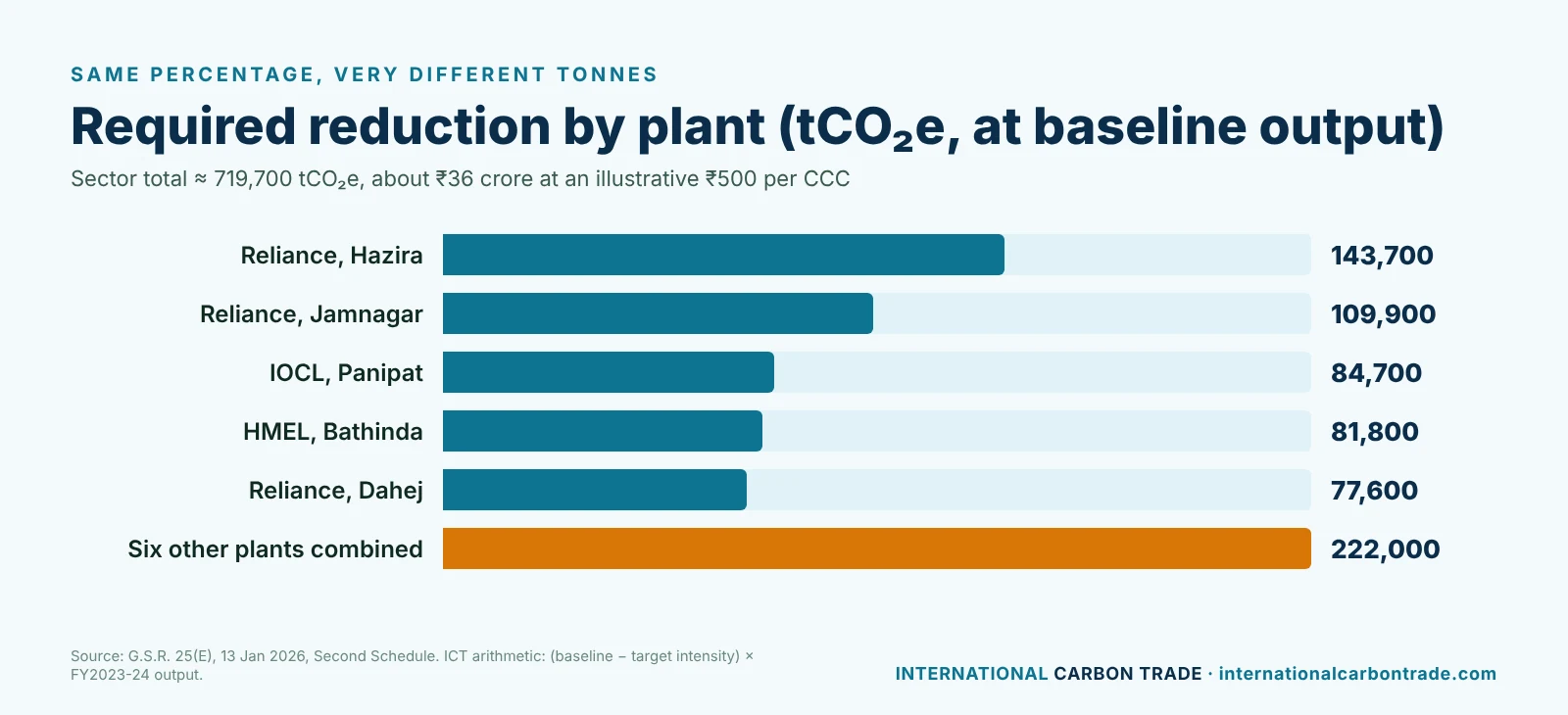
| Rank | Plant | Required cut (tCO₂e) |
|---|---|---|
| 1 | Reliance, Hazira | 143,700 |
| 2 | Reliance, Jamnagar | 109,900 |
| 3 | IOCL, Panipat | 84,700 |
| 4 | HMEL, Bathinda | 81,800 |
| 5 | Reliance, Dahej | 77,600 |
| – | Six other plants | 222,000 |
| | Sector total | ≈ 719,700 |
ICT arithmetic: (baseline − target intensity) × FY2023-24 output. At an illustrative ₹500 per CCC, the whole sector's obligation is worth about ₹36 crore. This uniform cut sits inside the January 2026 Gazette, which also holds a few odd textile rows.
One Company, Half the Cut
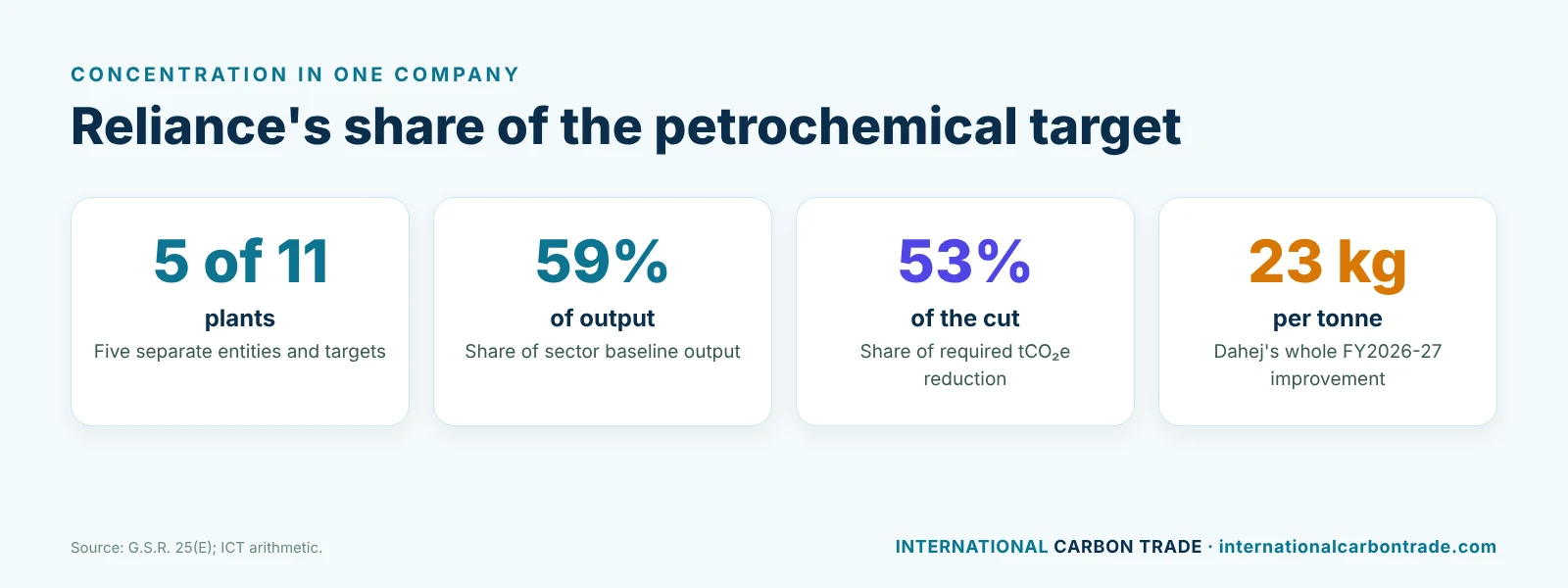
Seven companies stand behind the 11 plants. Reliance runs five, with 59% of baseline output and 53% of the required reduction. Each plant is a separate obligated entity, so a surplus at one site cannot cover another's shortfall without buying and surrendering CCCs through the power exchanges.
Why the Cleanest Plant Isn't the Smallest Obligation
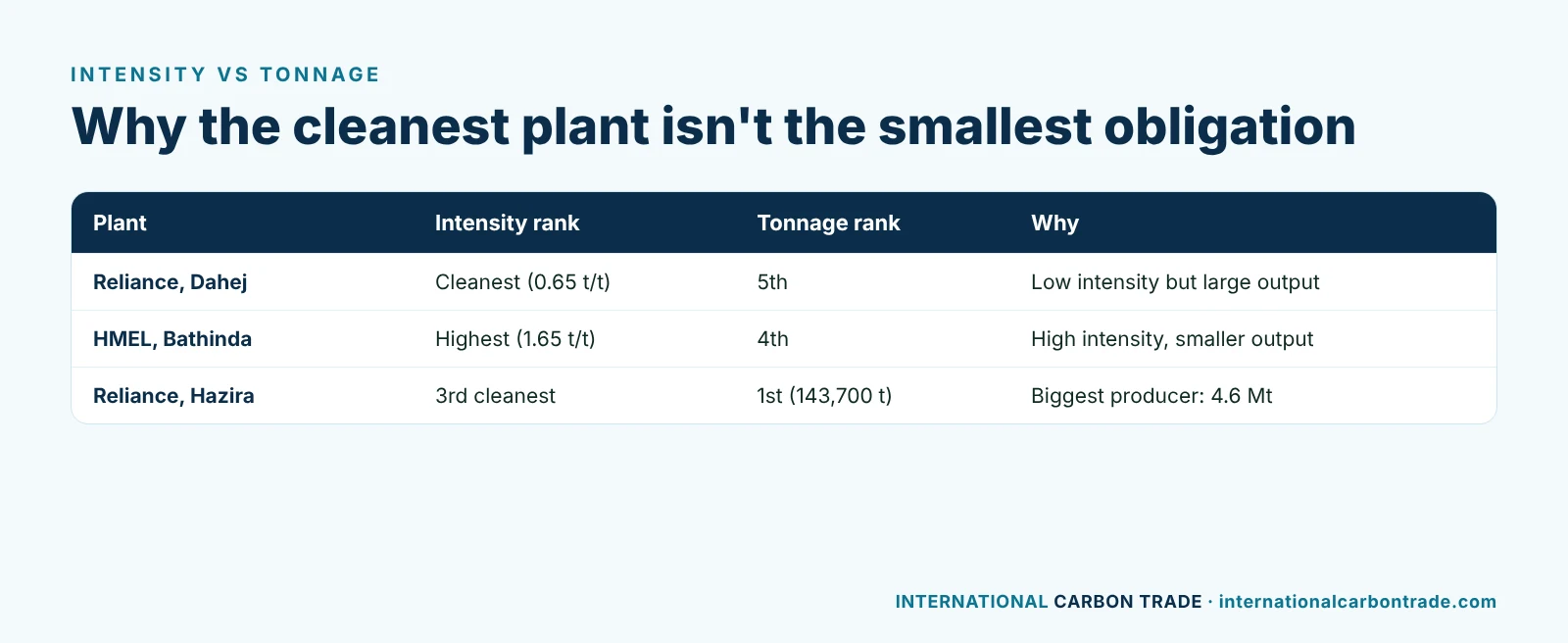
Dahej is the cleanest plant at 0.65 tCO₂e/t, yet ranks fifth on tonnes; its improvement is just 23 kg per tonne. Bathinda has the highest intensity at 1.65 and must find 58 kg per tonne. Hazira, at 4.6 Mt of output, carries the largest bill. Intensity sets the percentage; output sets the tonnes. As of 22 October 2026, no CCC has traded, and meeting target exactly earns zero credits.
ICT helps petrochemical plants turn a percentage into a plan: plant-level gap analysis, monthly dMRV and a buy, abate or bank decision for each site.
Free plant gap estimate: email your plant's Gazette code to contact@internationalcarbontrade.com for your tonnes to cut and an indicative CCC cost.
Keep Reading
- The January 2026 CCTS Gazette, Explained
- Is CCTS Cap and Trade? Intensity Targets, Zero Credits, Banking
- Carbon Marketplace vs Power Exchange: Who Executes CCC Trades?
Our CCTS Services
International Carbon Trade (ICT) is an India-based CCTS marketplace and dMRV platform offering 18 end-to-end services, from BEE ICM Portal registration and ACVA verification to buying, selling and banking CCCs on India's power exchanges.
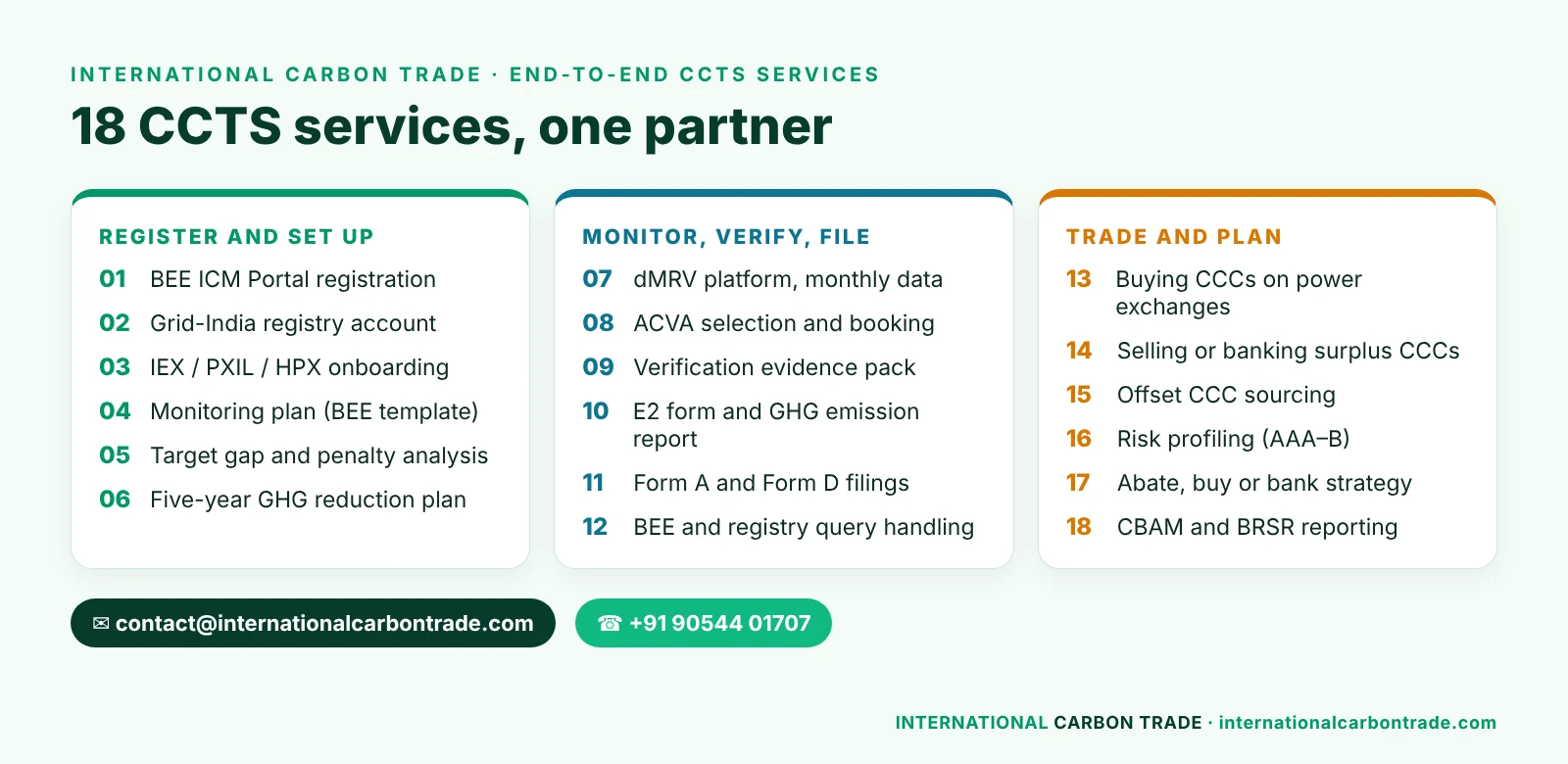
| Register and Set Up | Monitor, Verify, File | Trade and Plan |
|---|---|---|
| BEE ICM Portal registration | dMRV platform, monthly data | Buying CCCs on power exchanges |
| Grid-India registry account | ACVA selection and booking | Selling or banking surplus CCCs |
| IEX / PXIL / HPX onboarding | Verification evidence pack | Offset CCC sourcing |
| Monitoring plan (BEE template) | E2 form and GHG emission report | Risk profiling (AAA–B) |
| Target gap and penalty analysis | Form A and Form D filings | Abate, buy or bank strategy |
| Five-year GHG reduction plan | BEE and registry query handling | CBAM and BRSR reporting |
For any services related to CCTS, contact International Carbon Trade:
- Email: contact@internationalcarbontrade.com
- Phone: +91 90544 01707
- Website: internationalcarbontrade.com
- LinkedIn: Follow International Carbon Trade
Frequently Asked Questions
- How many petrochemical plants are under CCTS?
- Eleven petrochemical plants run by seven companies are listed in G.S.R. 25(E) of 13 January 2026.
- What is the petrochemical CCTS target?
- Every plant must cut emission intensity by 3.55% against its FY2023-24 baseline by FY2026-27.
- Which petrochemical plant has the largest obligation?
- Reliance Hazira, at about 143,700 tCO2e, because it is the largest producer at 4.6 Mt of output.
- How much of the cut falls on Reliance?
- Reliance runs five of the 11 plants, with about 59% of output and 53% of the required reduction.
- Can one Reliance plant's surplus cover another's shortfall?
- Not directly. Each plant is a separate obligated entity; a shortfall is met by buying and surrendering CCCs.
- How can ICT help petrochemical companies?
- International Carbon Trade offers gap analysis, dMRV, ACVA support and CCC trading. Contact contact@internationalcarbontrade.com or +91 90544 01707.