Aluminium Recycling Under CCTS: Hindalco's Three Plants Explained
Aluminium recycling under India's CCTS: Hindalco's three secondary plants, their targets, the 9,150 tCO2e annual ask, and the gap with primary aluminium.
India's CCTS names exactly three secondary (recycled) aluminium plants, and all three belong to Hindalco Industries. They were added by the January 2026 Gazette (G.S.R. 25(E)). Here is each plant's case.
Plant 1: Hirakud FRP, Odisha
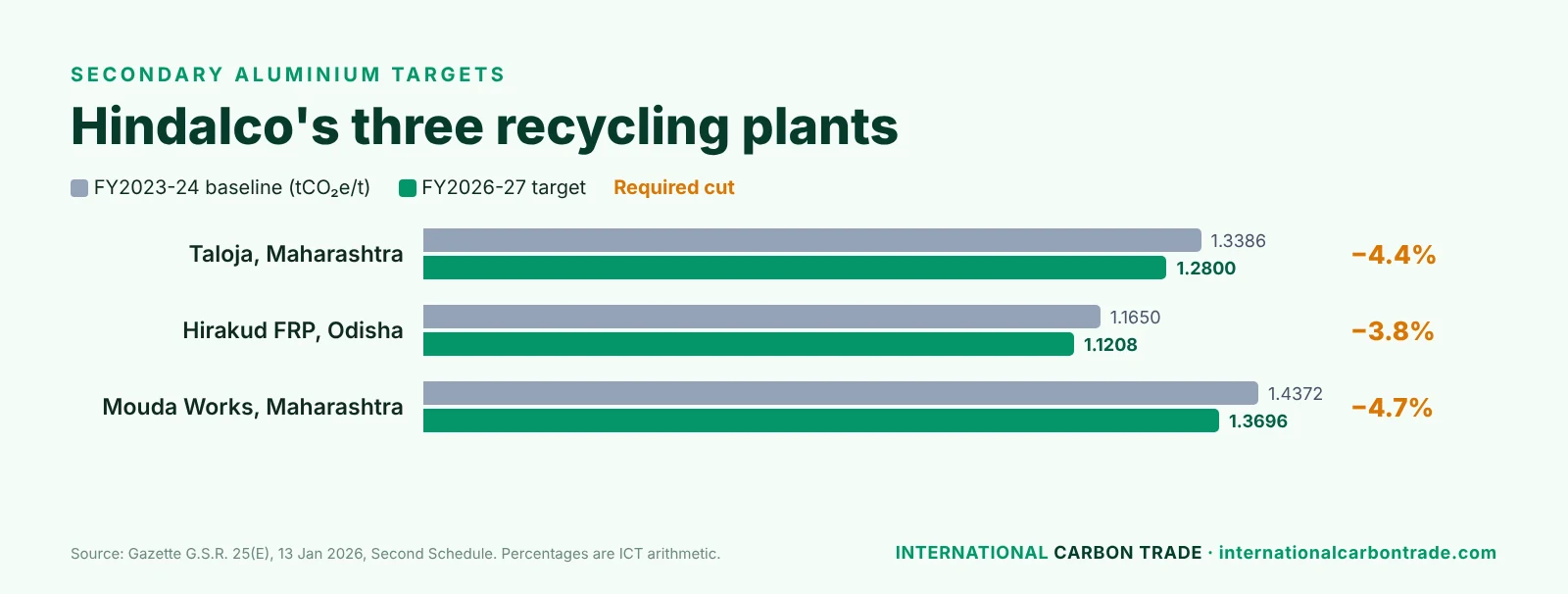
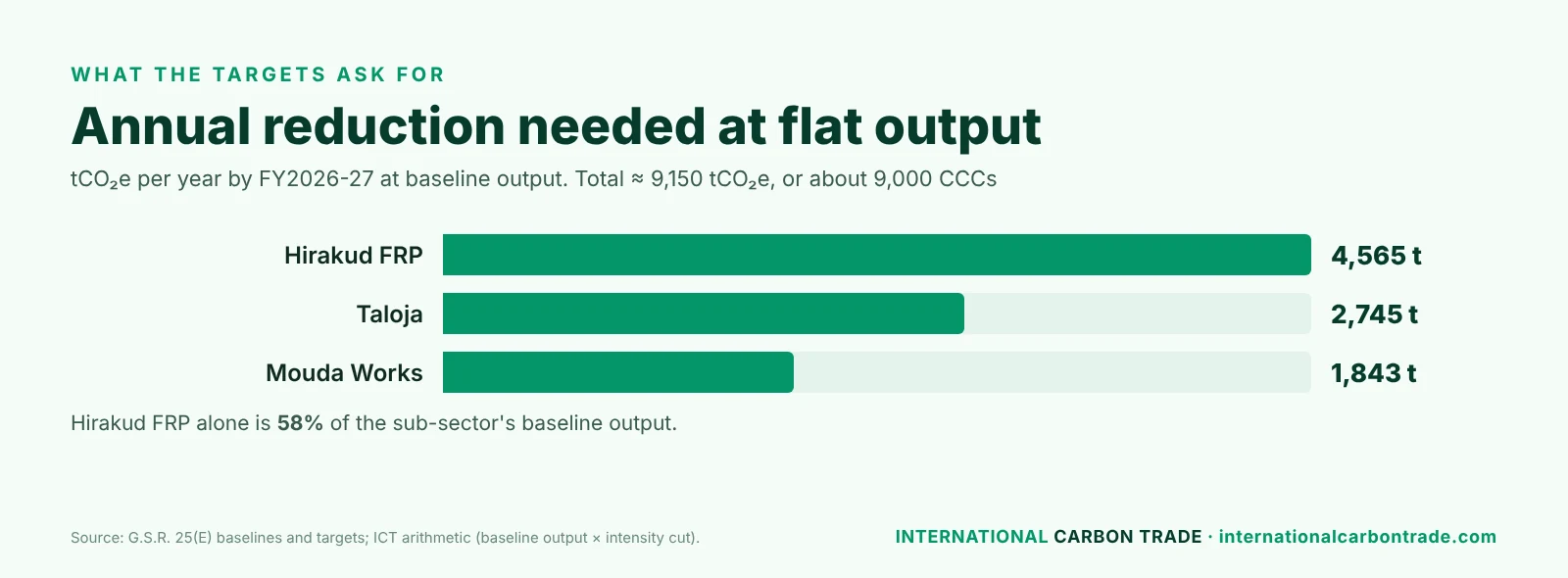
The giant of the group, with 103,292 t of baseline output, 58% of the sub-sector. Intensity must fall from 1.1650 to 1.1208 tCO₂e/t, a 3.8% cut, or about 4,565 tCO₂e a year at flat output.
Plant 2: Taloja, Maharashtra
46,845 t of output. Target 1.3386 → 1.2800, a 4.4% cut, about 2,745 tCO₂e a year.
Plant 3: Mouda Works, Maharashtra
The smallest at 27,265 t, but the steepest cut: 1.4372 → 1.3696, or 4.7%, about 1,843 tCO₂e a year.
What the Numbers Add Up To
Together, the sub-sector must cut about 9,150 tCO₂e a year, roughly 9,000 Carbon Credit Certificates of value. Because these plants were notified in January 2026, Note 3 makes the FY2025-26 target pro-rata for January–March only, so the first-year cut is just 0.5–0.7%.
The Bigger Picture: Primary vs Recycled
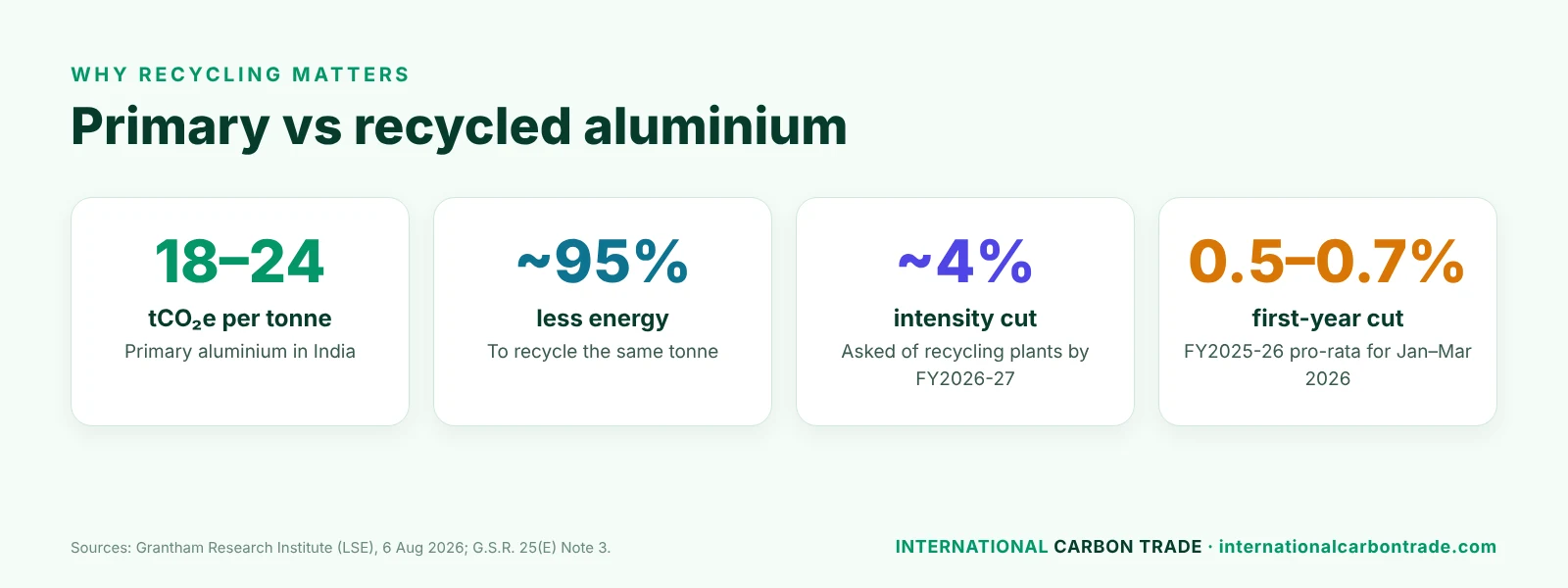
Primary aluminium in India emits about 18–24 tCO₂e per tonne; recycling needs roughly 95% less energy (Grantham Research Institute, LSE). Yet each primary smelter is measured only against its own past, never the cleaner route. Recycling also relies on imported scrap, which limits how fast it can scale. And aluminium faces EU CBAM and UK CBAM at the border.
ICT supports aluminium producers with target gap analysis, dMRV monitoring and CBAM reporting, so recycled-metal gains show up in verified numbers.
Free aluminium gap check: email your plant's Gazette code to contact@internationalcarbontrade.com for your tonnes to cut and CBAM exposure.
Keep Reading
- The January 2026 CCTS Gazette, Explained
- Iron and Steel Under CCTS: 255 Plants, Draft Targets Explained
- Is CCTS Cap and Trade? Intensity Targets, Zero Credits, Banking
Our CCTS Services
International Carbon Trade (ICT) is an India-based CCTS marketplace and dMRV platform offering 18 end-to-end services, from BEE ICM Portal registration and ACVA verification to buying, selling and banking CCCs on India's power exchanges.
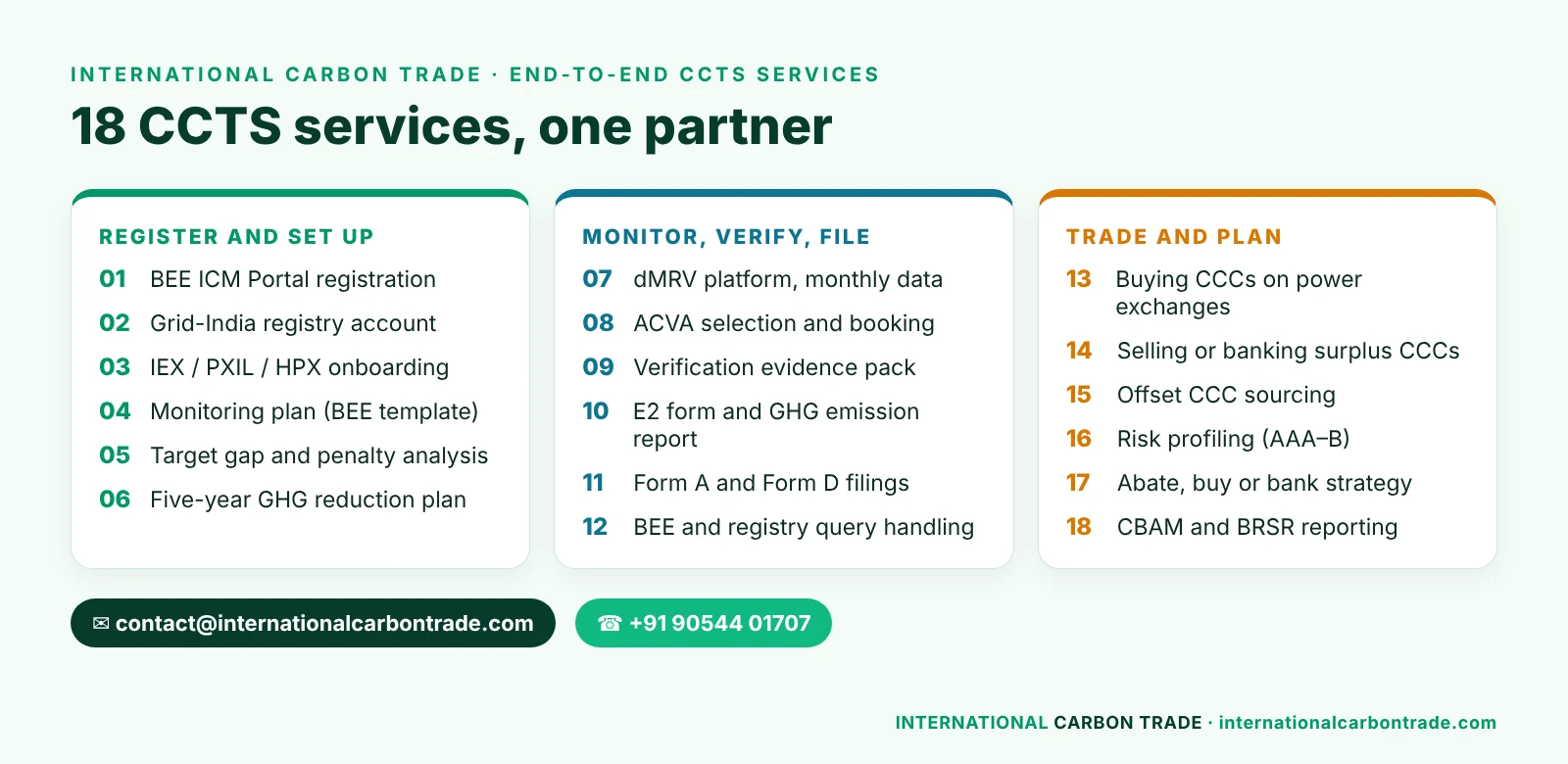
| Register and Set Up | Monitor, Verify, File | Trade and Plan |
|---|---|---|
| BEE ICM Portal registration | dMRV platform, monthly data | Buying CCCs on power exchanges |
| Grid-India registry account | ACVA selection and booking | Selling or banking surplus CCCs |
| IEX / PXIL / HPX onboarding | Verification evidence pack | Offset CCC sourcing |
| Monitoring plan (BEE template) | E2 form and GHG emission report | Risk profiling (AAA–B) |
| Target gap and penalty analysis | Form A and Form D filings | Abate, buy or bank strategy |
| Five-year GHG reduction plan | BEE and registry query handling | CBAM and BRSR reporting |
For any services related to CCTS, contact International Carbon Trade:
- Email: contact@internationalcarbontrade.com
- Phone: +91 90544 01707
- Website: internationalcarbontrade.com
- LinkedIn: Follow International Carbon Trade
Frequently Asked Questions
- Which secondary aluminium plants are under CCTS?
- Three Hindalco Industries plants: Hirakud FRP in Odisha, and Taloja and Mouda Works in Maharashtra, listed in G.S.R. 25(E) of 13 January 2026.
- How big are the secondary aluminium CCTS targets?
- Intensity cuts of 3.8% to 4.7% by FY2026-27, about 4.1% weighted, or roughly 9,150 tCO2e a year at baseline output.
- Why is the first-year target so small?
- Because the plants were notified in January 2026, the FY2025-26 target covers only January to March 2026, giving a cut of about 0.5% to 0.7%.
- How much cleaner is recycled aluminium?
- Recycling aluminium needs about 95% less energy than primary production, which emits roughly 18 to 24 tCO2e per tonne in India.
- Are primary aluminium smelters also under CCTS?
- Yes. Primary smelters and alumina refineries have their own CCTS targets, each set against the plant's own baseline.
- How can ICT help aluminium producers?
- International Carbon Trade offers target gap analysis, dMRV monitoring and CBAM reporting. Contact contact@internationalcarbontrade.com or +91 90544 01707.