Refinery Emission Intensity Under CCTS: Which Column Should You Read?
Which Indian refinery is cleanest under CCTS? The Gazette's printed intensity and the carbon per barrel give two different leaderboards. Here is why.

Ask which Indian refinery is the cleanest under the Carbon Credit Trading Scheme and the answer depends on which column of the Gazette you read.
Two Numbers on Every Refinery Row
The refinery table in G.S.R. 25(E) (13 January 2026) prints each of the 21 refineries' baseline intensity in tCO₂e per thousand barrels per NRGF, next to a factor column headed NRGF. The Gazette text does not spell the acronym out, but the unit tells you how it works: multiply the two and you get tonnes of CO₂e per thousand barrels of crude.
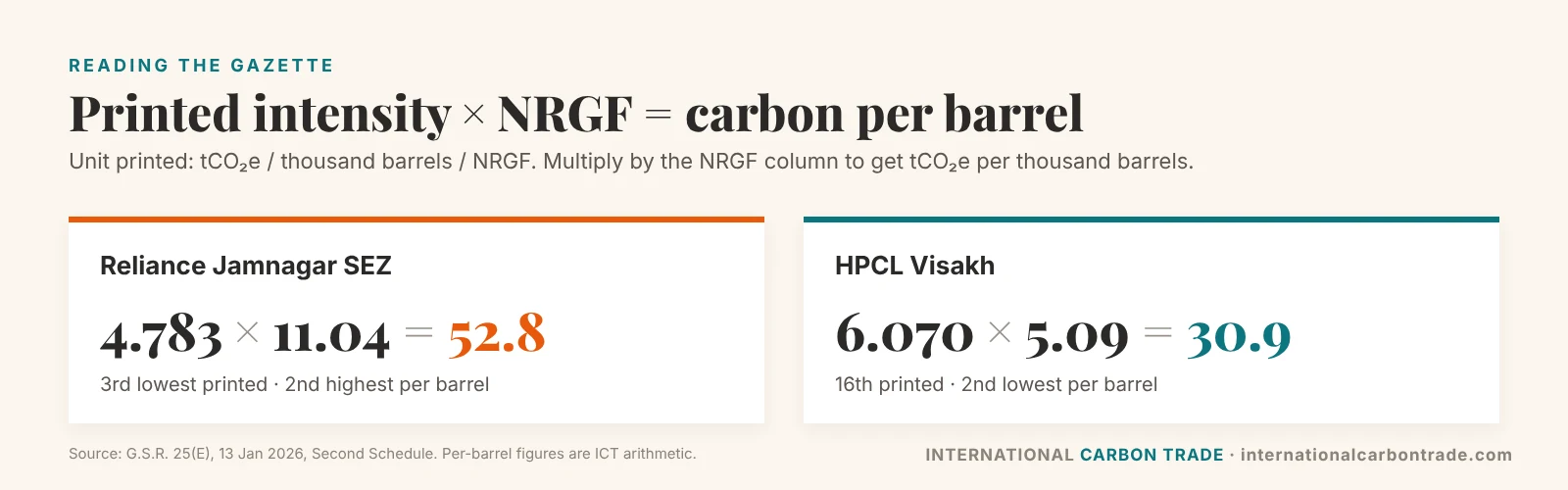
Same Plants, Two Leaderboards
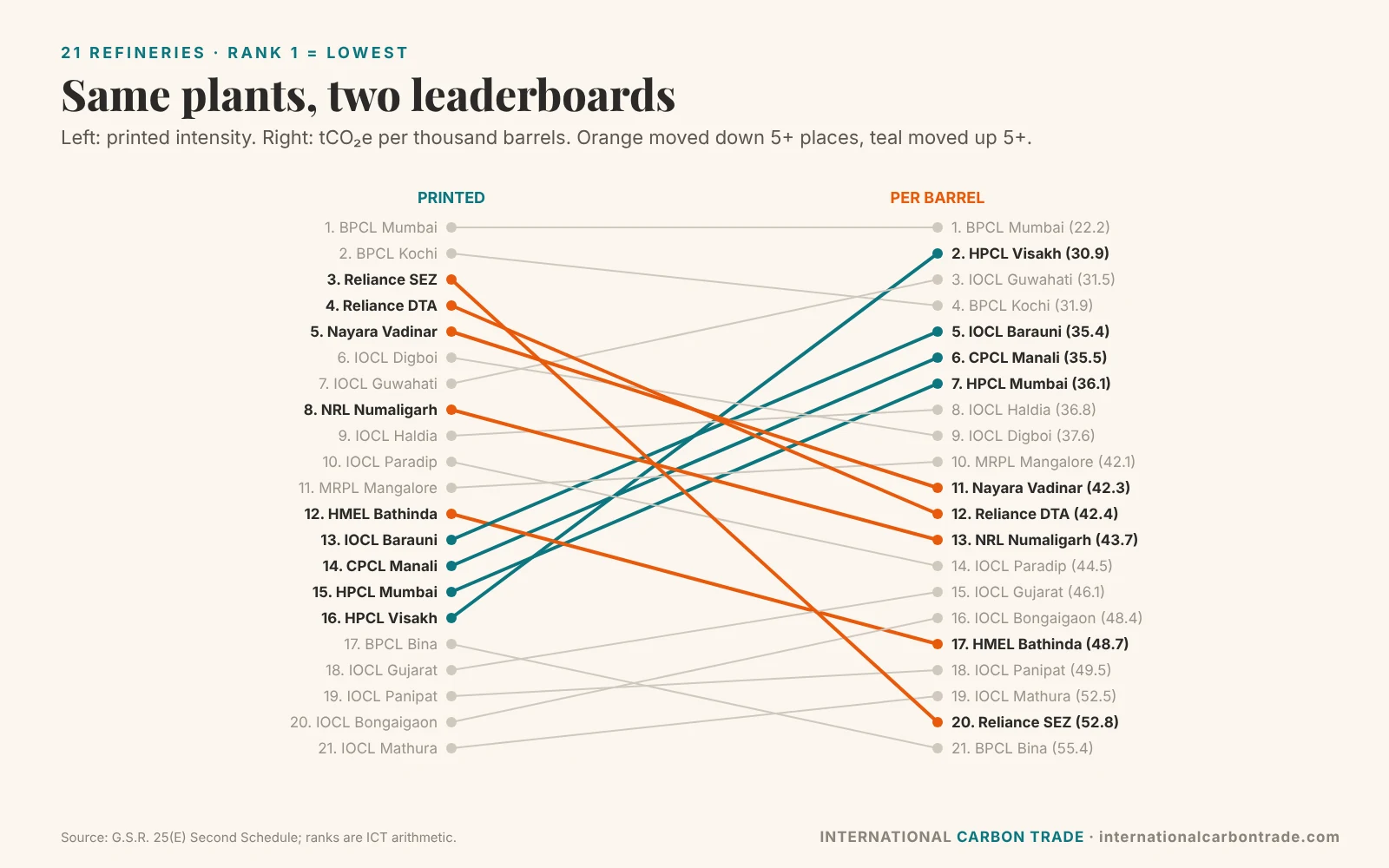
| Refinery | Printed rank | Per-barrel rank |
|---|---|---|
| BPCL Mumbai | 1 | 1 |
| Reliance Jamnagar SEZ | 3 | 20 |
| Reliance Jamnagar DTA | 4 | 12 |
| HPCL Visakh | 16 | 2 |
| CPCL Manali | 14 | 6 |
| BPCL Bina | 17 | 21 |
Rank 1 = lowest. ICT arithmetic from the Gazette's Second Schedule. Nine of 21 refineries move five places or more. Neither column is "wrong": the factor exists so that complex refineries, which do more processing per barrel, are compared fairly. The printed number answers "how efficient for its complexity?"; the per-barrel number answers "how much carbon per barrel?".
Which Column Sets Your Target?
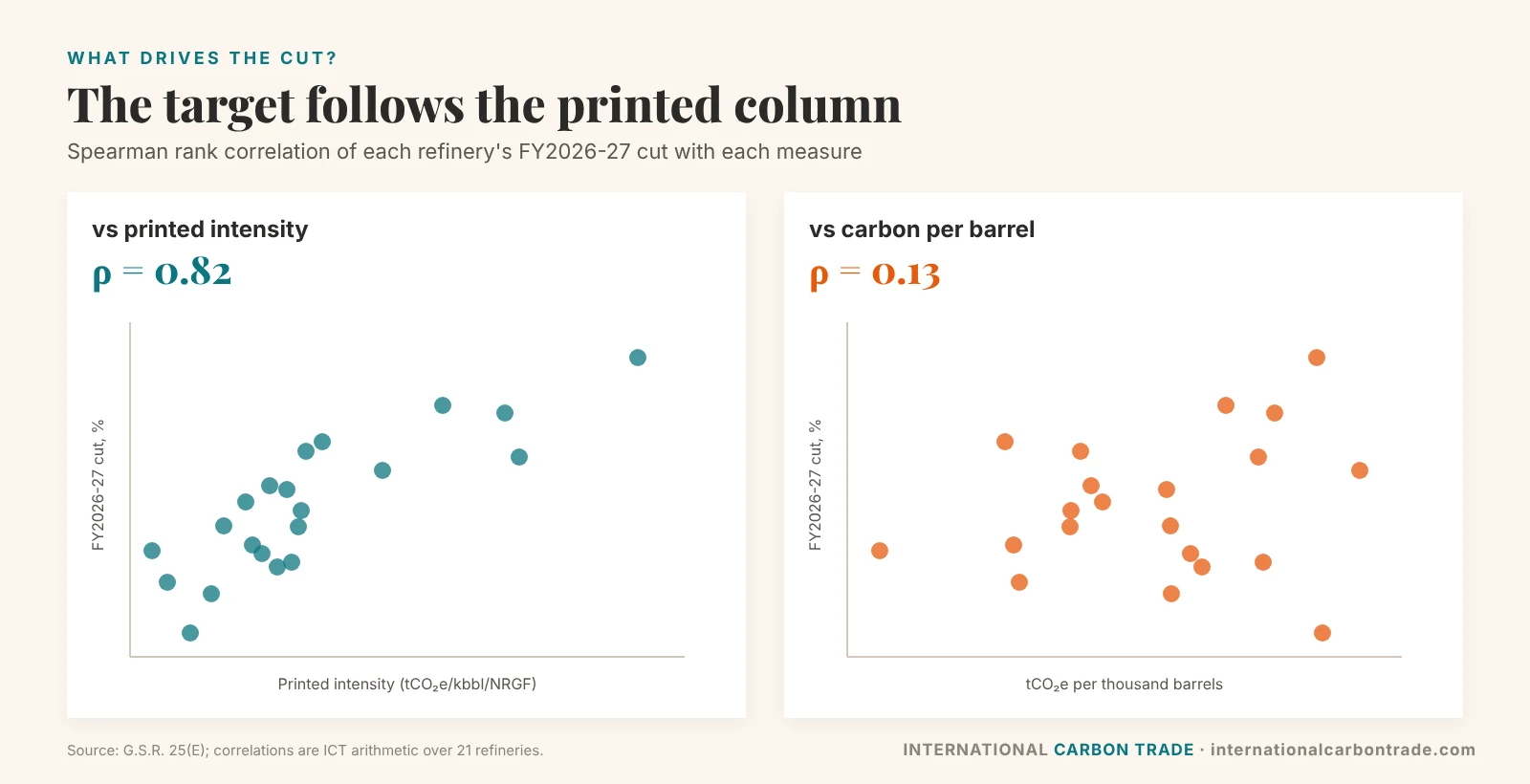
The cut follows the printed column. Rank correlation of the FY2026-27 cut with printed intensity is 0.82; with carbon per barrel, just 0.13. IOCL Mathura must cut 5.80%; Reliance SEZ 1.57%; the median is 3.45%. Together the 21 targets ask for about 2.64 MtCO₂e, 3.2% of roughly 82 Mt baseline emissions. Because the factor sits in the denominator, a change in how your factor is computed moves your intensity too, so check it before your ACVA does. As of 22 October 2026, no CCC has traded.
ICT helps refineries read both columns: we rebuild your intensity from monthly dMRV data, test the factor, and model whether you will earn or buy CCCs.
Free check for refiners: email your Gazette code (e.g. REFOE021GJ) to contact@internationalcarbontrade.com and we'll send back both numbers and your FY2026-27 gap.
Keep Reading
- The January 2026 CCTS Gazette, Explained
- Petrochemical Plants Under CCTS: 11 Units, One Uniform Cut
- Is CCTS Cap and Trade? Intensity Targets, Zero Credits, Banking
Our CCTS Services
International Carbon Trade (ICT) is an India-based CCTS marketplace and dMRV platform offering 18 end-to-end services, from BEE ICM Portal registration and ACVA verification to buying, selling and banking CCCs on India's power exchanges.
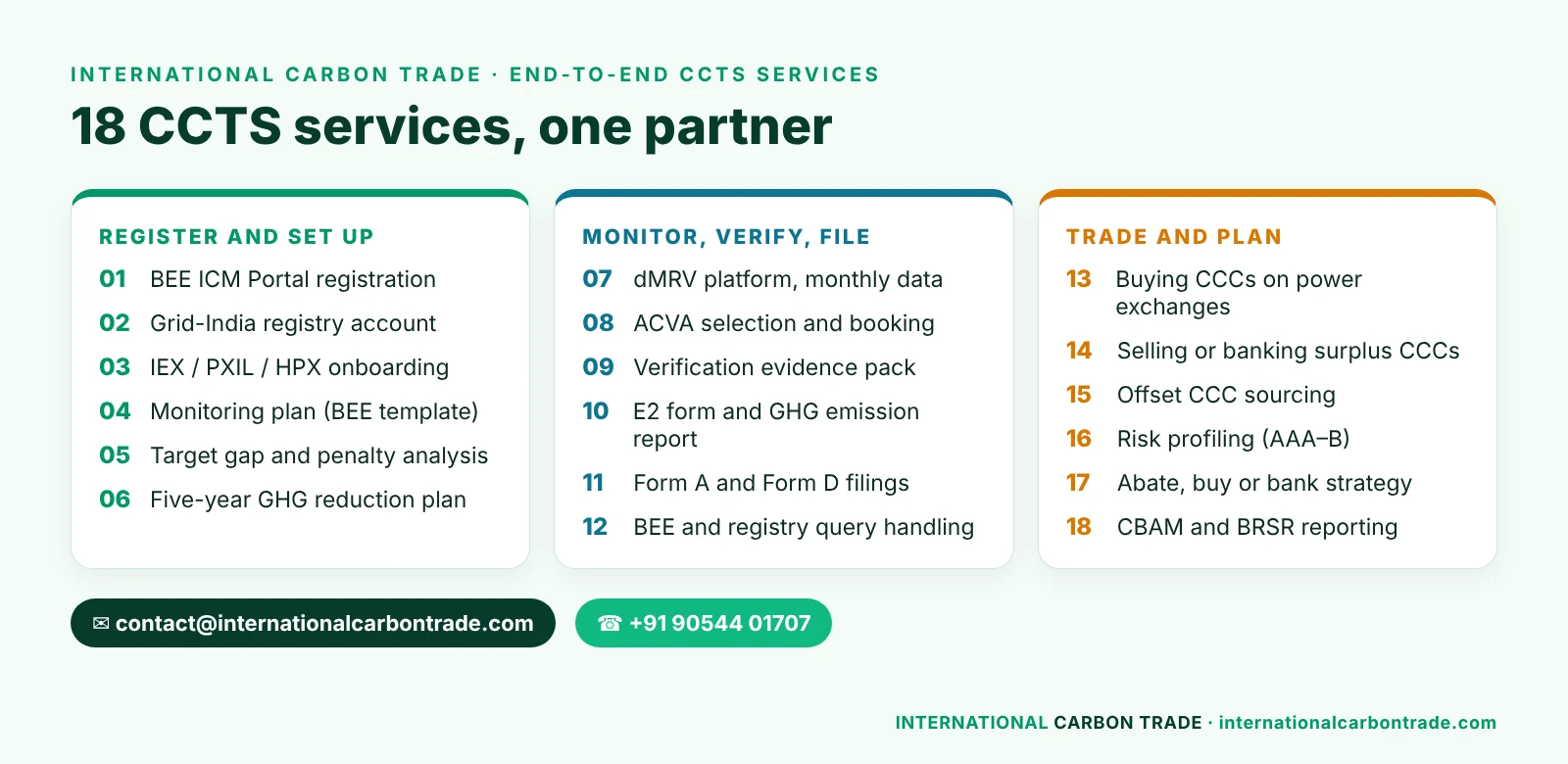
| Register and Set Up | Monitor, Verify, File | Trade and Plan |
|---|---|---|
| BEE ICM Portal registration | dMRV platform, monthly data | Buying CCCs on power exchanges |
| Grid-India registry account | ACVA selection and booking | Selling or banking surplus CCCs |
| IEX / PXIL / HPX onboarding | Verification evidence pack | Offset CCC sourcing |
| Monitoring plan (BEE template) | E2 form and GHG emission report | Risk profiling (AAA–B) |
| Target gap and penalty analysis | Form A and Form D filings | Abate, buy or bank strategy |
| Five-year GHG reduction plan | BEE and registry query handling | CBAM and BRSR reporting |
For any services related to CCTS, contact International Carbon Trade:
- Email: contact@internationalcarbontrade.com
- Phone: +91 90544 01707
- Website: internationalcarbontrade.com
- LinkedIn: Follow International Carbon Trade
Frequently Asked Questions
- How many refineries are under CCTS?
- 21 petroleum refineries are listed in the Second Schedule of G.S.R. 25(E), dated 13 January 2026.
- What unit is used for refinery CCTS targets?
- Tonnes of CO2e per thousand barrels of crude throughput per NRGF, a factor printed in its own column of the Gazette.
- How do I get tonnes of CO2e per barrel from the Gazette?
- Multiply the printed intensity by the NRGF factor. The result is tonnes of CO2e per thousand barrels of crude.
- Which refinery has the lowest emission intensity under CCTS?
- BPCL Mumbai ranks lowest on both the printed intensity and the carbon per barrel.
- How large are refinery CCTS cuts?
- FY2026-27 cuts range from about 1.6% to 5.8%, with a median of about 3.5%, totalling about 2.64 MtCO2e.
- How can ICT help refineries with CCTS?
- International Carbon Trade offers dMRV, target gap analysis and CCC trading support. Contact contact@internationalcarbontrade.com or +91 90544 01707.