Is CCTS Cap and Trade? Intensity Targets, Zero Credits, Banking
Is India's CCTS a cap and trade system? No. Four myths about intensity targets, zero credits, banking and carbon prices, with real Gazette examples.
People often call India's Carbon Credit Trading Scheme a "cap and trade system". It isn't, and the difference changes how plants should plan. Here are four common myths.
Myth 1: CCTS Caps Total Emissions
Fact: CCTS sets an intensity target, tCO₂e per tonne of product, against a FY2023-24 baseline. Produce more and total emissions can rise while you stay compliant. Climate Risk Horizons (July 2026) puts near-term cuts for steel, cement and aluminium at only 2–5% by FY2026-27. China ran the same design and has signalled a shift to absolute caps for major sectors by 2027.
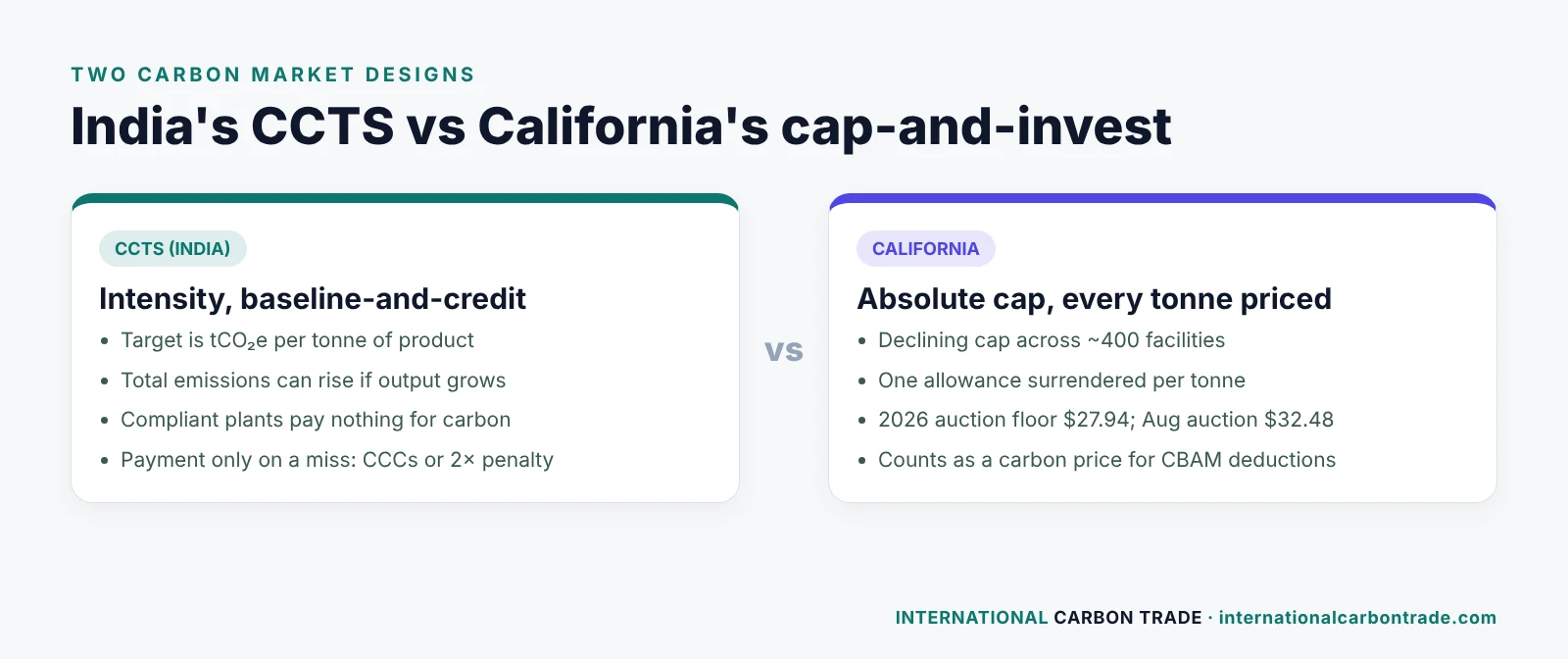
Myth 2: Every Tonne Has a Price
Fact: California's cap-and-invest makes every covered facility surrender one allowance per tonne (2026 floor $27.94; August auction $32.48). Under CCTS, a compliant plant pays nothing for carbon. That's lighter at home, but it is also why the EU may see nothing to deduct (read why).
Myth 3: Hitting Your Target Earns Credits
Fact: Hit it exactly and you earn zero CCCs. Credits = (target − achieved intensity) × production.
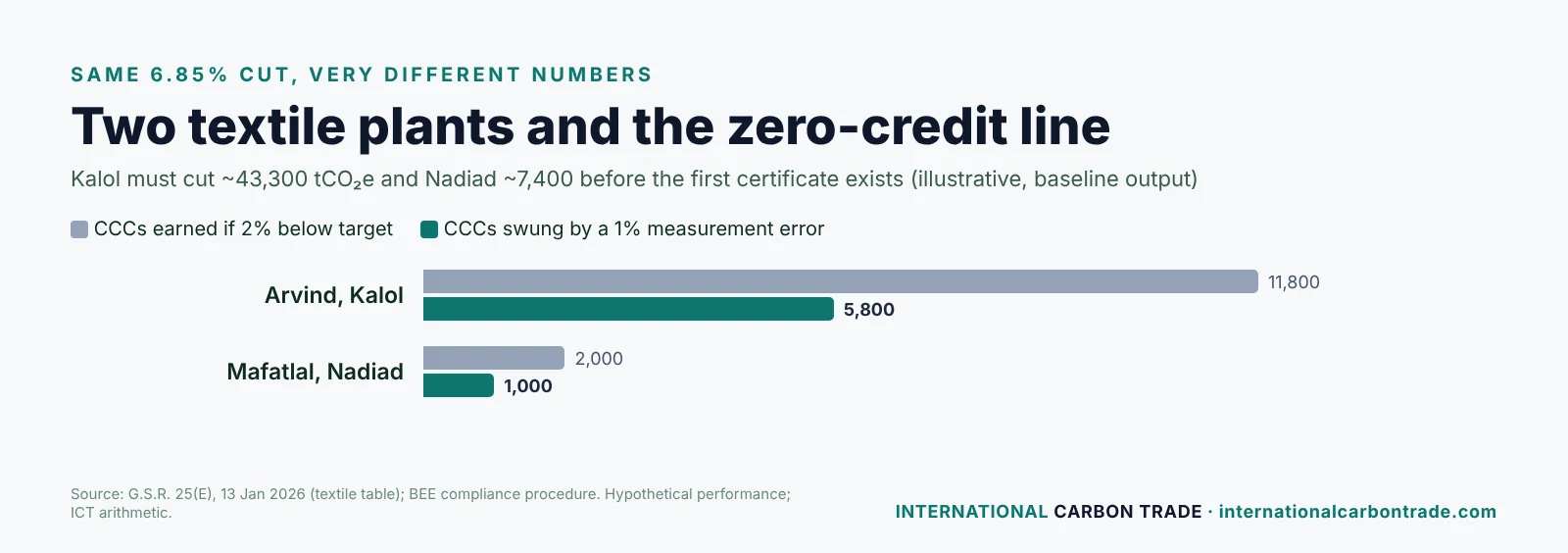
| Plant (Gazette G.S.R. 25(E)) | Cut to remove before first credit | CCCs if 2% below target | Swing from 1% data error |
|---|---|---|---|
| Arvind, Kalol | ~43,300 tCO₂e | ~11,800 | ~5,800 |
| Mafatlal, Nadiad | ~7,400 tCO₂e | ~2,000 | ~1,000 |
Illustrative, at baseline output. Not either company's actual results. A 1% measurement error moves almost half the surplus, so data quality decides how many credits exist.
Myth 4: Unlimited Banking Is Harmless
Fact: CCCs don't expire today. Other markets, and India's own PAT scheme, show surplus can sink prices.
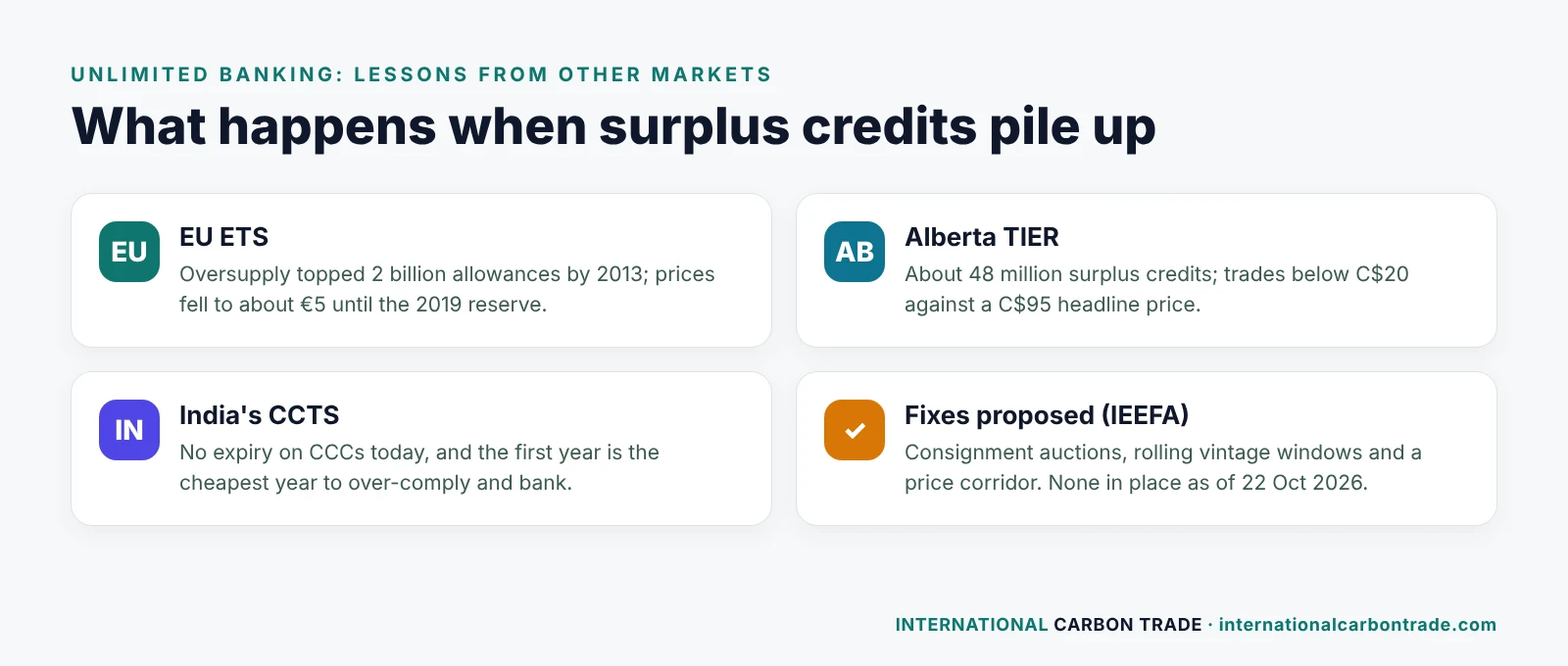
As of 22 October 2026, none of IEEFA's proposed safeguards (consignment auctions, rolling vintages, a price corridor) is in place.
ICT runs the target-gap analysis, keeps your intensity data verifier-ready through dMRV, and builds your abate, buy or bank strategy.
Free credit estimate: email your Gazette code and latest production to contact@internationalcarbontrade.com, and we'll estimate your CCCs at 1% and 2% below target.
Keep Reading
- Carbon Credit Certificate (CCC) in India: Complete CCTS Guide
- Carbon Marketplace vs Power Exchange: Who Executes CCC Trades?
- Iron and Steel Under CCTS: 255 Plants, Draft Targets Explained
Our CCTS Services
International Carbon Trade (ICT) is an India-based CCTS marketplace and dMRV platform offering 18 end-to-end services, from BEE ICM Portal registration and ACVA verification to buying, selling and banking CCCs on India's power exchanges.
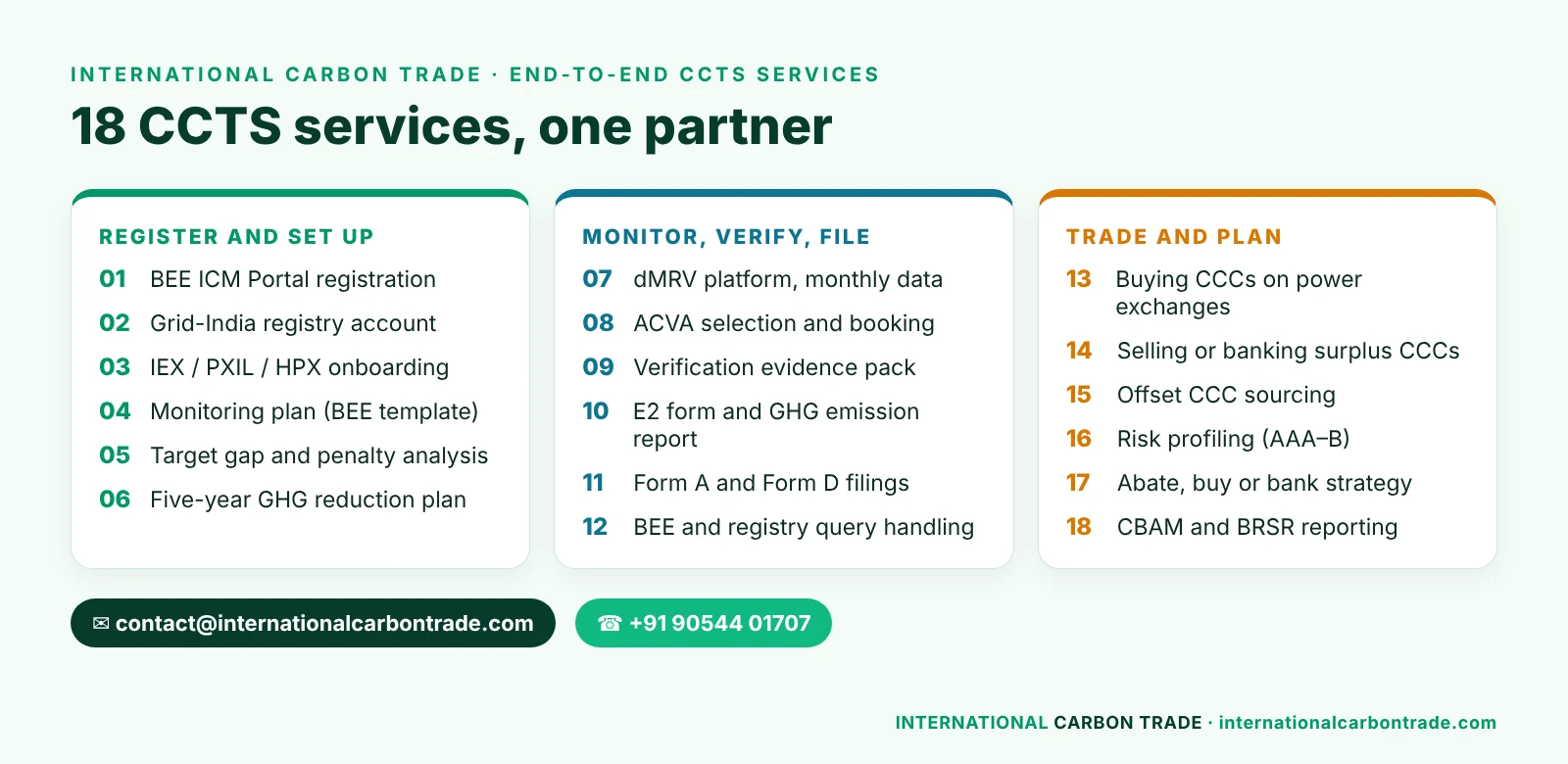
| Register and Set Up | Monitor, Verify, File | Trade and Plan |
|---|---|---|
| BEE ICM Portal registration | dMRV platform, monthly data | Buying CCCs on power exchanges |
| Grid-India registry account | ACVA selection and booking | Selling or banking surplus CCCs |
| IEX / PXIL / HPX onboarding | Verification evidence pack | Offset CCC sourcing |
| Monitoring plan (BEE template) | E2 form and GHG emission report | Risk profiling (AAA–B) |
| Target gap and penalty analysis | Form A and Form D filings | Abate, buy or bank strategy |
| Five-year GHG reduction plan | BEE and registry query handling | CBAM and BRSR reporting |
For any services related to CCTS, contact International Carbon Trade:
- Email: contact@internationalcarbontrade.com
- Phone: +91 90544 01707
- Website: internationalcarbontrade.com
- LinkedIn: Follow International Carbon Trade
Frequently Asked Questions
- Is India's CCTS a cap and trade system?
- No. CCTS is a baseline-and-credit scheme with emission intensity targets per tonne of product, not an absolute cap on total emissions.
- Can total emissions rise under CCTS?
- Yes. If output grows, total emissions can rise while a plant still meets its intensity target and stays compliant.
- Does meeting a CCTS target earn carbon credits?
- No. Meeting the target exactly earns zero CCCs. Credits are issued only for the gap below the target, multiplied by production.
- Do CCTS carbon credits expire?
- Not under current rules. Surplus CCCs can be banked for future compliance years with no vintage expiry.
- How is CCTS different from California's cap-and-invest?
- California prices every covered tonne through allowances. Under CCTS a compliant plant pays nothing for carbon and pays only on a shortfall.
- How can ICT help with CCTS planning?
- International Carbon Trade offers target gap analysis, dMRV monitoring and abate, buy or bank strategy. Contact contact@internationalcarbontrade.com or +91 90544 01707.