EU CBAM 2026 Update: What Is Law and What Is Only Proposed
EU CBAM in October 2026: downstream products are in trilogue and the phase-in slowdown is only proposed. What is law today for Indian exporters.
Headlines say the EU has "widened" and "slowed" its Carbon Border Adjustment Mechanism (CBAM). As of 22 October 2026, neither is law. For Indian exporters of steel, aluminium and cement, planning around the wrong version could leave you years out.
What Is Law and What Is Only Proposed?
Today's CBAM scope and the 2034 phase-in end date remain law. Everything else below is still being negotiated.
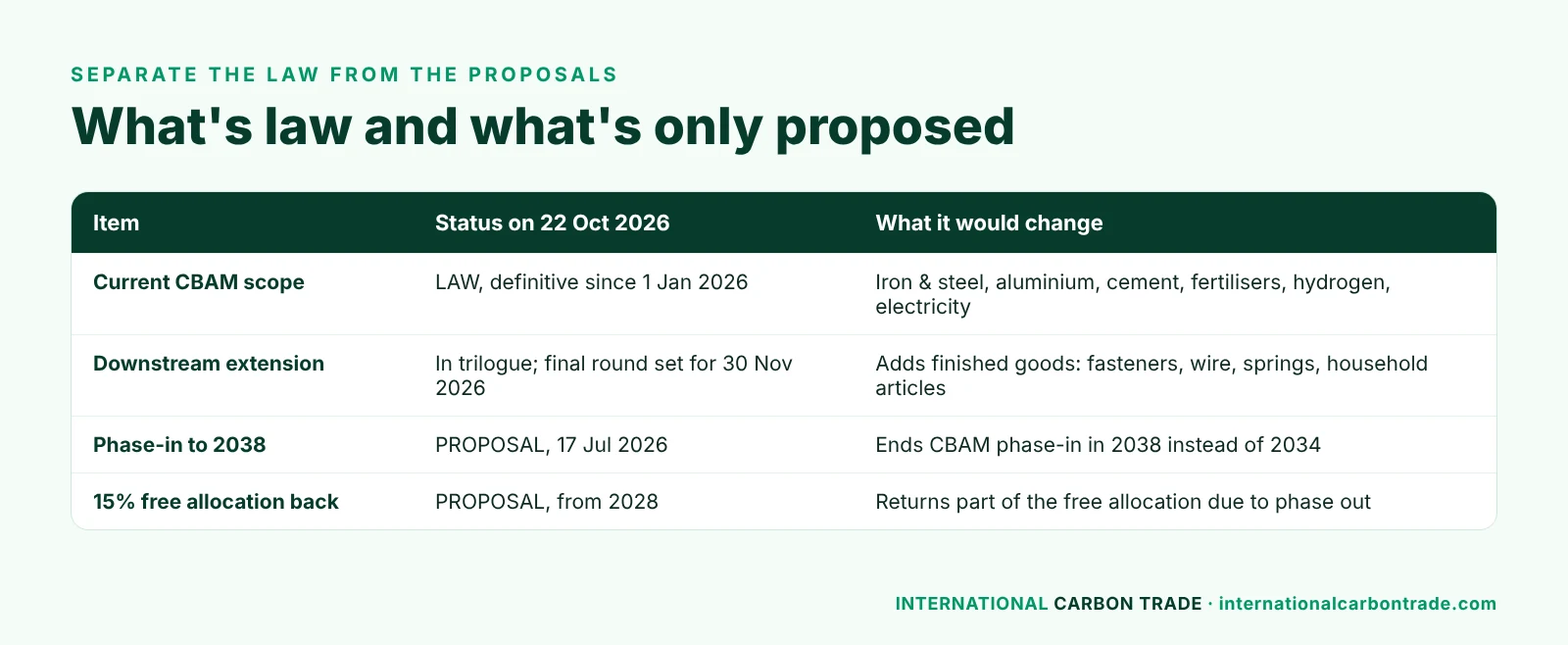
| Item | Status on 22 Oct 2026 |
|---|---|
| Current scope (steel, aluminium, cement, fertilisers, hydrogen, electricity) | Law, definitive since 1 Jan 2026 |
| Downstream extension | In trilogue; final round provisionally 30 Nov 2026 |
| Phase-in ending 2038, not 2034 | Proposal (17 Jul 2026) |
| 15% of free allocation returned from 2028 | Proposal |
The Downstream Extension: How Wide?
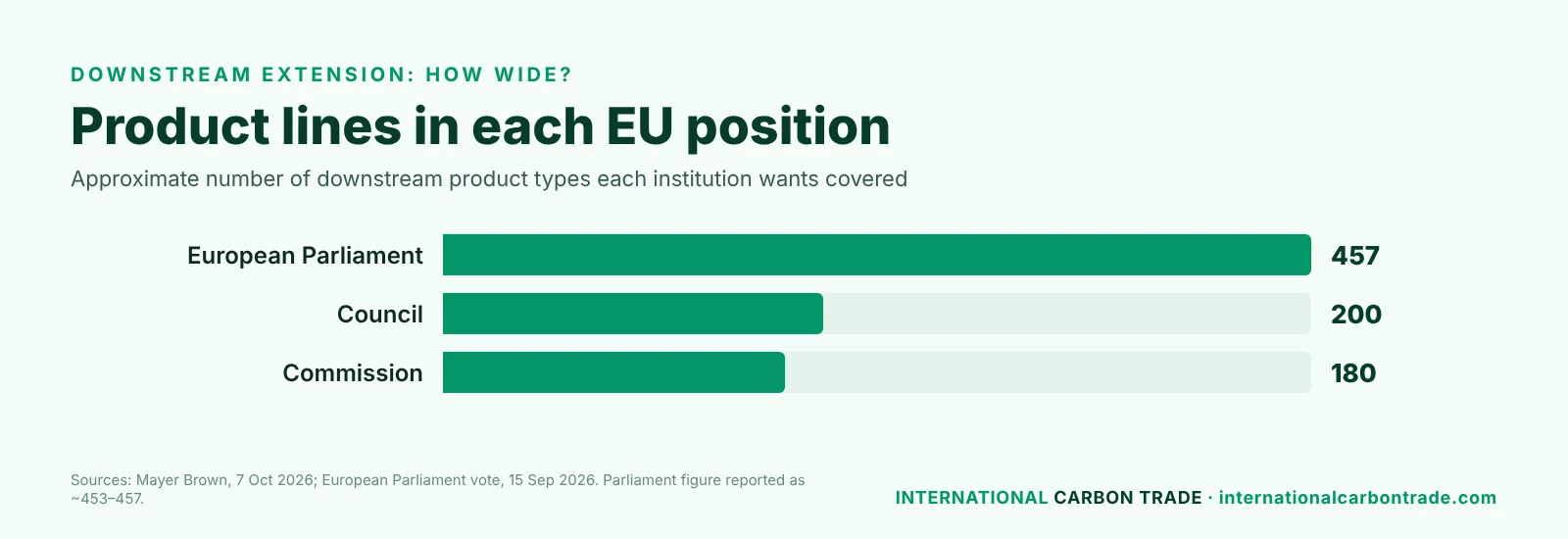
On 15 September 2026, the European Parliament voted 464 to 50 (159 abstentions) to extend CBAM to downstream goods such as fasteners, wire, springs and household articles. Parliament wants about 457 product lines, the Council about 200 and the Commission about 180. Trilogue began on 28 September, with political rounds on 20 October and 30 November 2026. As of 22 October 2026, no agreement has been announced.
Why Downstream Exporters Should Care
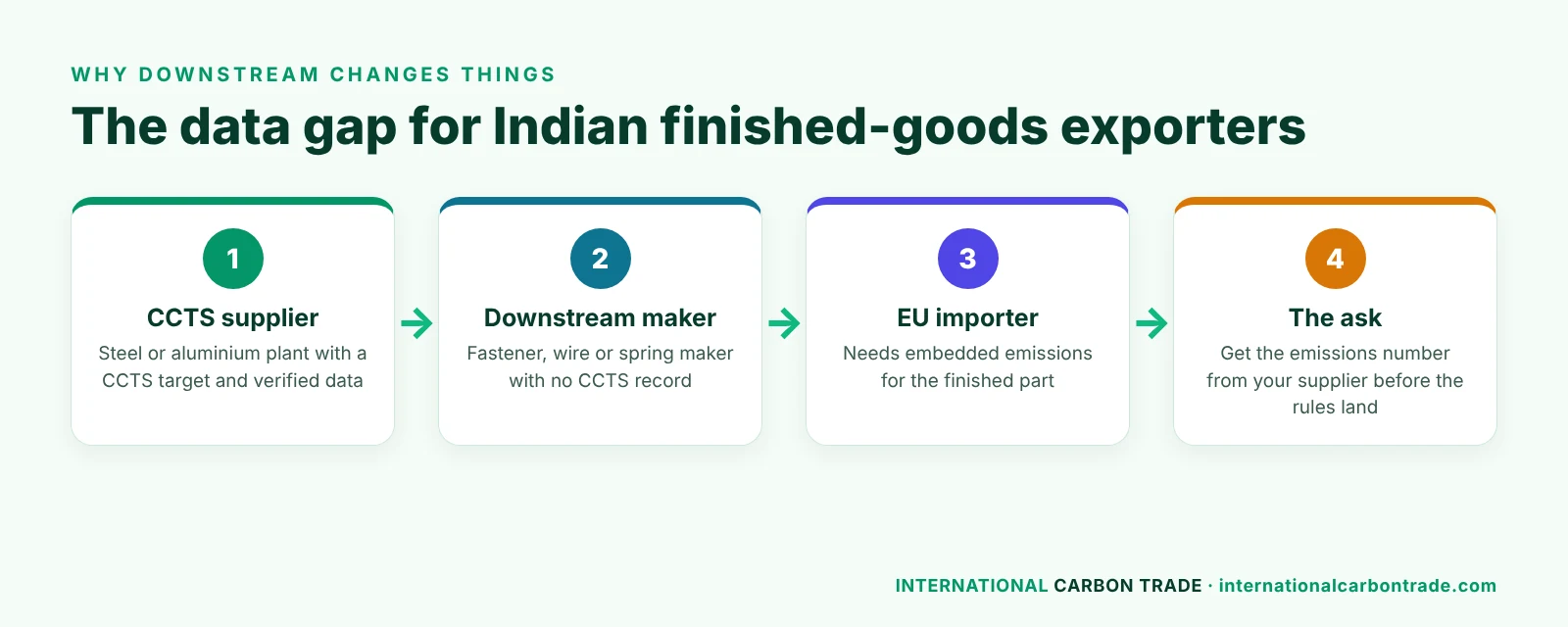
Steel and aluminium plants under CCTS already monitor and verify emissions. A fastener or wire maker buying from them usually doesn't. If the extension becomes law, that company will still owe EU importers embedded-emissions data. Ask your supplier for the number now.
The Slowdown Proposal
On 17 July 2026, the Commission proposed returning 15% of free allocation from 2028 and ending the CBAM phase-in in 2038 instead of 2034. EU ministers debated it on 12 October without a decision. The Council aims for a position in December 2026 and leaders want it finished by end-Q1 2027.
A later end date means a smaller EU charge for longer on paper. It does not mean the data can wait. For what a tonne costs today, see the Q3 2026 CBAM certificate price.
Try it: estimate emissions with our Emission Calculator.
How International Carbon Trade Helps
ICT helps Indian exporters build plant-level emissions data once, through our dMRV platform, and reuse it for CCTS and CBAM reporting.
Free downstream exposure check: email your HS codes to contact@internationalcarbontrade.com, and we'll tell you whether they appear in the downstream proposals.
Keep Reading
- CBAM Certificate Price Q3 2026 Explained for Indian Exporters
- CBAM Carbon Tax Deduction: Can CCTS Cut Your EU CBAM Bill?
- UK CBAM Default Values 2027: What Indian Exporters Must Know
Our CCTS Services
International Carbon Trade (ICT) is an India-based CCTS marketplace and dMRV platform offering 18 end-to-end services, from BEE ICM Portal registration and ACVA verification to buying, selling and banking CCCs on India's power exchanges.
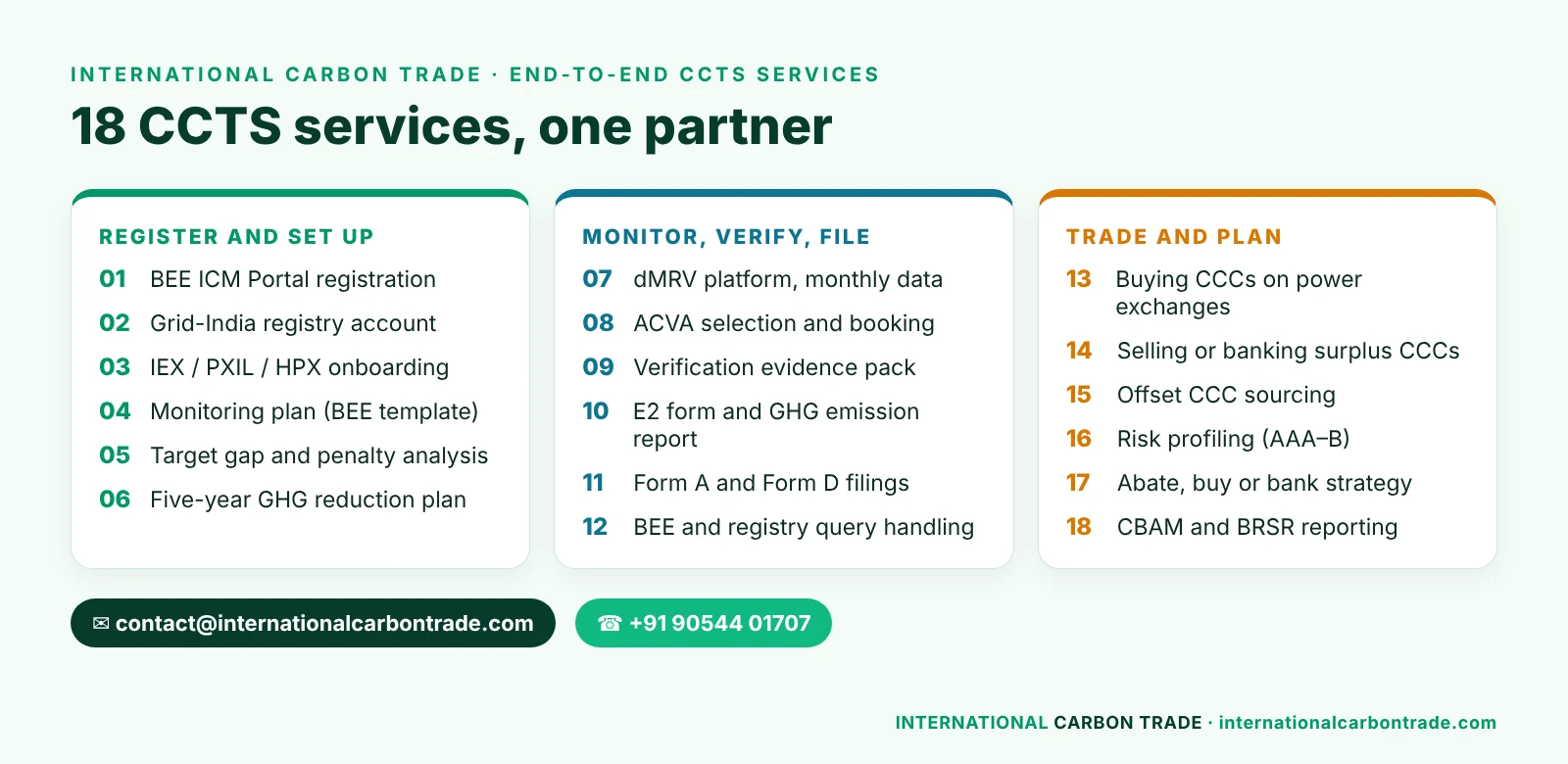
| Register and Set Up | Monitor, Verify, File | Trade and Plan |
|---|---|---|
| BEE ICM Portal registration | dMRV platform, monthly data | Buying CCCs on power exchanges |
| Grid-India registry account | ACVA selection and booking | Selling or banking surplus CCCs |
| IEX / PXIL / HPX onboarding | Verification evidence pack | Offset CCC sourcing |
| Monitoring plan (BEE template) | E2 form and GHG emission report | Risk profiling (AAA–B) |
| Target gap and penalty analysis | Form A and Form D filings | Abate, buy or bank strategy |
| Five-year GHG reduction plan | BEE and registry query handling | CBAM and BRSR reporting |
For any services related to CCTS, contact International Carbon Trade:
- Email: contact@internationalcarbontrade.com
- Phone: +91 90544 01707
- Website: internationalcarbontrade.com
- LinkedIn: Follow International Carbon Trade
Frequently Asked Questions
- Has the EU CBAM downstream extension become law?
- No. As of 22 October 2026 it is in trilogue negotiations between the Parliament, Council and Commission, with a final round provisionally set for 30 November 2026.
- Which downstream products could CBAM cover?
- Proposals include steel and aluminium goods such as fasteners, wire, springs and household articles. Positions range from about 180 to about 457 product lines.
- Has the EU delayed CBAM to 2038?
- Not yet. The Commission proposed ending the phase-in in 2038 instead of 2034 on 17 July 2026, but current law still runs to 2034.
- Which products does EU CBAM cover today?
- Iron and steel, aluminium, cement, fertilisers, hydrogen and electricity, mainly primary and semi-finished goods. The definitive phase began on 1 January 2026.
- Do Indian downstream manufacturers need emissions data?
- If the extension passes, EU importers will need embedded-emissions data for finished goods, so manufacturers should ask their CCTS-covered suppliers for it now.
- How can ICT help with EU CBAM?
- International Carbon Trade helps exporters build verification-ready emissions data through its dMRV platform. Contact contact@internationalcarbontrade.com or +91 90544 01707.