ACVA Verification Process Under CCTS: 7 Steps to a CCC
The seven steps from monitoring plan to CCC issuance under CCTS: what an ACVA checks, Form A and Form B, the site visit and check verification.
Under India's Carbon Credit Trading Scheme (CCTS), no plant receives a Carbon Credit Certificate (CCC) until an Accredited Carbon Verification Agency (ACVA) has checked its data and signed Form B. Here are the seven steps in BEE's Detailed Procedure for Compliance Mechanism (v1.0, July 2024).
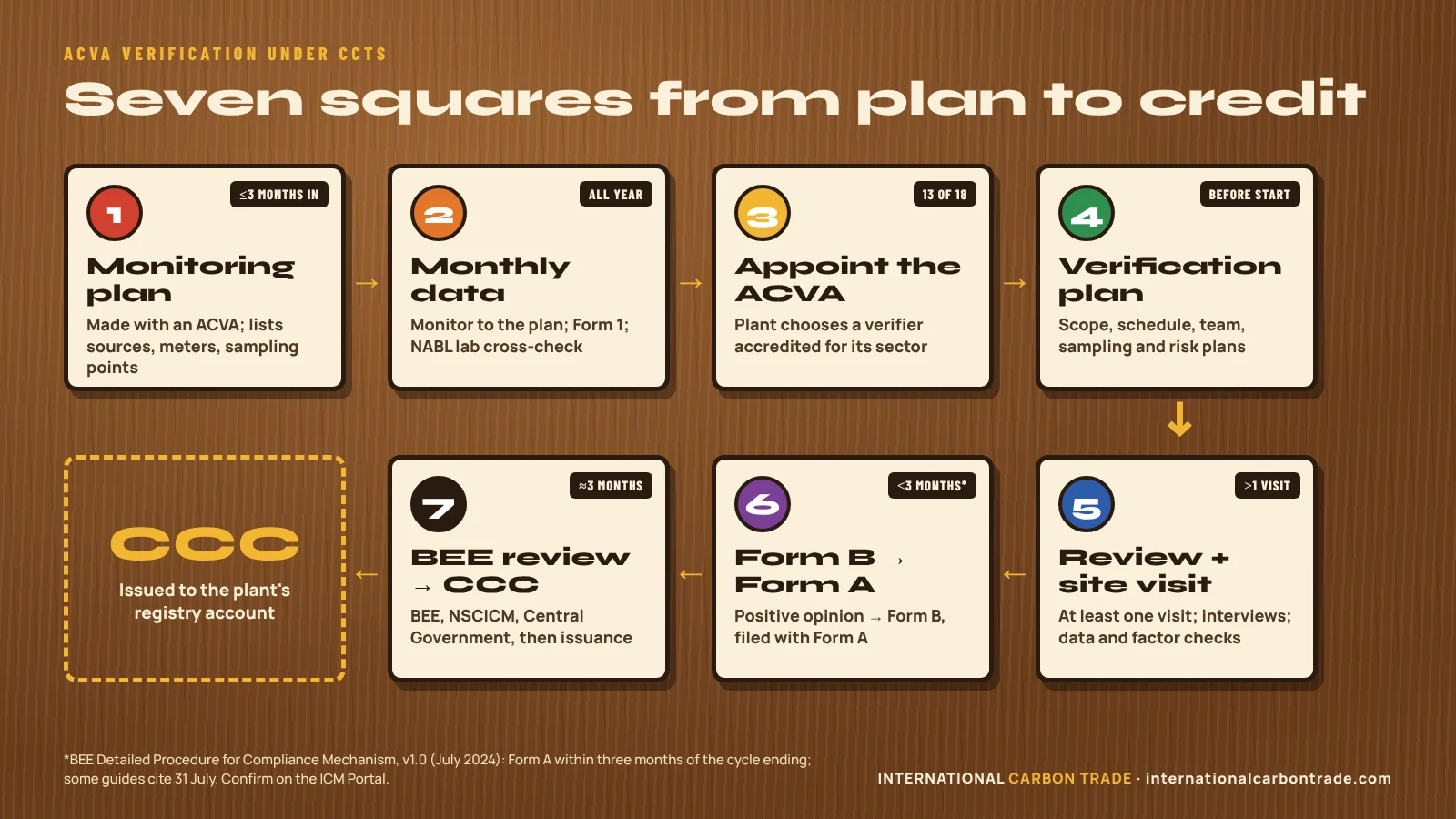
Step 1: Monitoring Plan
Prepared in consultation with an ACVA and submitted to BEE within three months of the compliance cycle starting. It lists emission sources, metering and sampling points, data flow and fuel testing.
Step 2: Monthly Data
The plant monitors to the plan and files Form 1 (annual energy and GHG emissions). Coal samples are also tested at a NABL-accredited lab; if its NCV differs from the plant lab's by more than 71.7 kcal/kg, the difference is added to the plant's result.
Step 3: Appoint the ACVA
The plant appoints the verifier. As of 22 October 2026, 13 of BEE's 18 ACVAs can verify compliance plants, and sector scope differs.
Step 4: Verification Plan
The ACVA sets scope, schedule, team, data sampling and risk plans, and shares team roles before work starts.
Step 5: Document Review and Site Visit
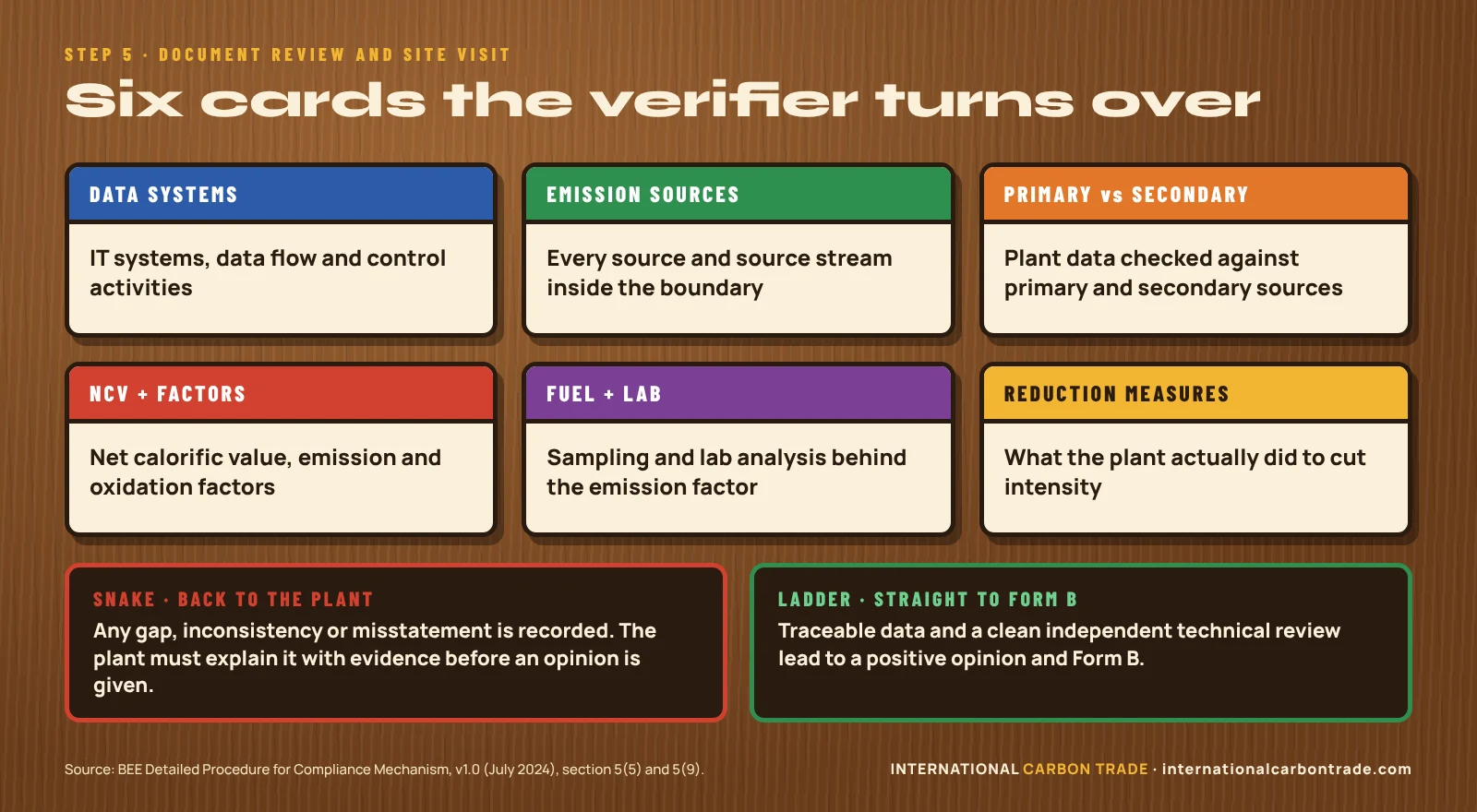
At least one site visit is mandatory. The verifier interviews staff, cross-checks primary and secondary data, and tests NCV, emission factors and calculations. An independent technical review follows.
Step 6: Form B, Then Form A
Gaps must be explained with evidence. A positive opinion leads to Form B, filed with the plant's Form A. The 2024 procedure says within three months of the cycle ending; some guides cite 31 July, so confirm on the ICM Portal.
Step 7: BEE Review and CCC Issuance
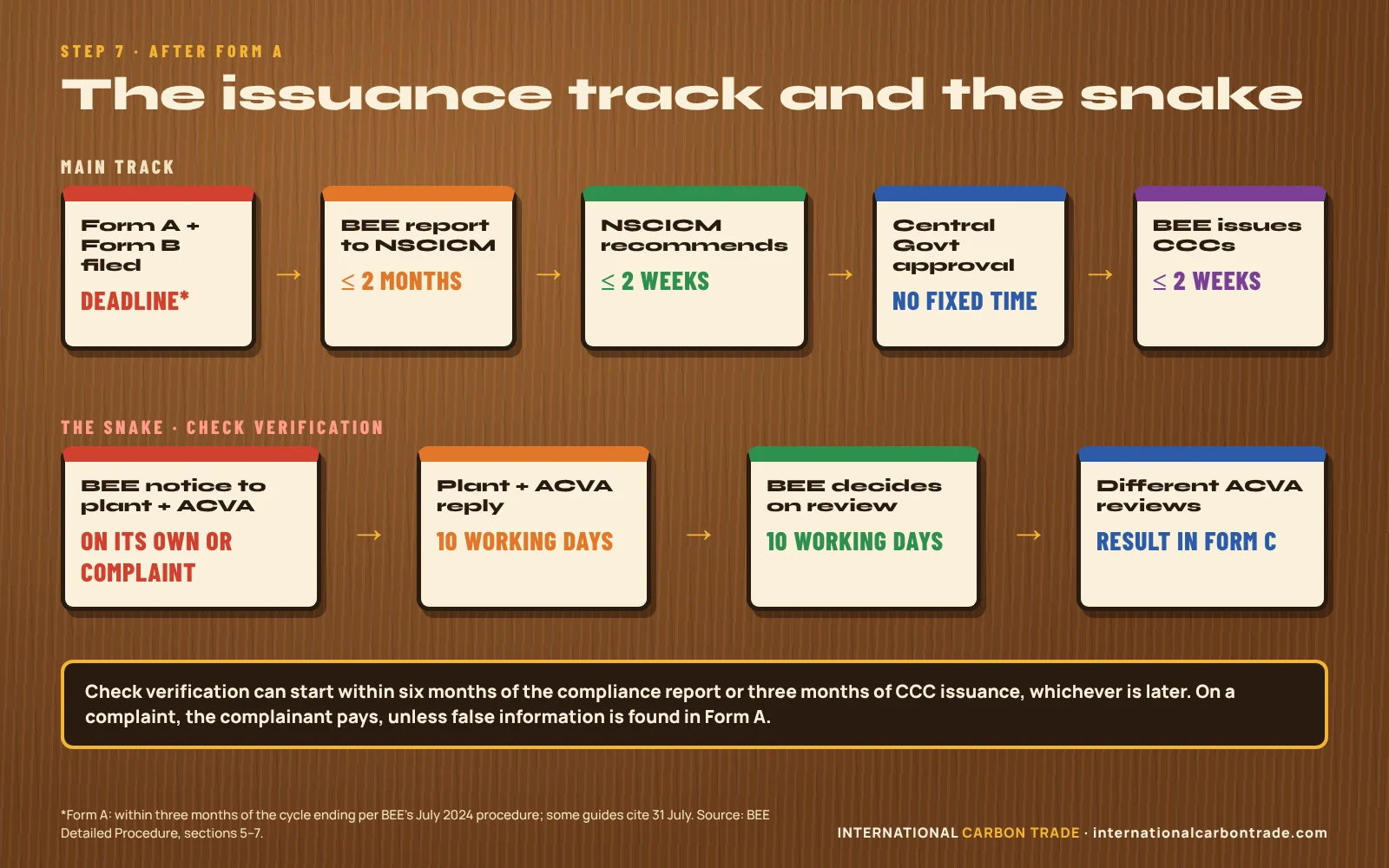
BEE reports to the NSCICM within two months, the NSCICM recommends within two weeks, and after Central Government approval BEE issues CCCs within two weeks. CCCs = (target − achieved intensity) × production, then traded on power exchanges.
Check verification: BEE may order a review by a different ACVA. On a complaint, the complainant pays, unless false information is found in Form A.
How International Carbon Trade Helps
ICT is not an ACVA. We keep your monthly data verification-ready, match you with sector-accredited ACVAs and build the evidence pack before the site visit. See how ICT supports every CCTS step.
Free pre-verification check: email your monitoring plan and one month of plant data to contact@internationalcarbontrade.com, and we will flag the gaps an ACVA is likely to question.
Sources: BEE Detailed Procedure for Compliance Mechanism, v1.0 (July 2024); BEE ACVA register (16 Oct 2026).
Keep Reading
- ACVA List India 2026: 18 Carbon Verifiers Under CCTS
- dMRV for CCTS: What Verification-Ready Data Looks Like
- Type I vs Type II Emission Factors: The CCTS Deadline in April 2027
Our CCTS Services
International Carbon Trade (ICT) is an India-based CCTS marketplace and dMRV platform offering 18 end-to-end services, from BEE ICM Portal registration and ACVA verification to buying, selling and banking CCCs on India's power exchanges.
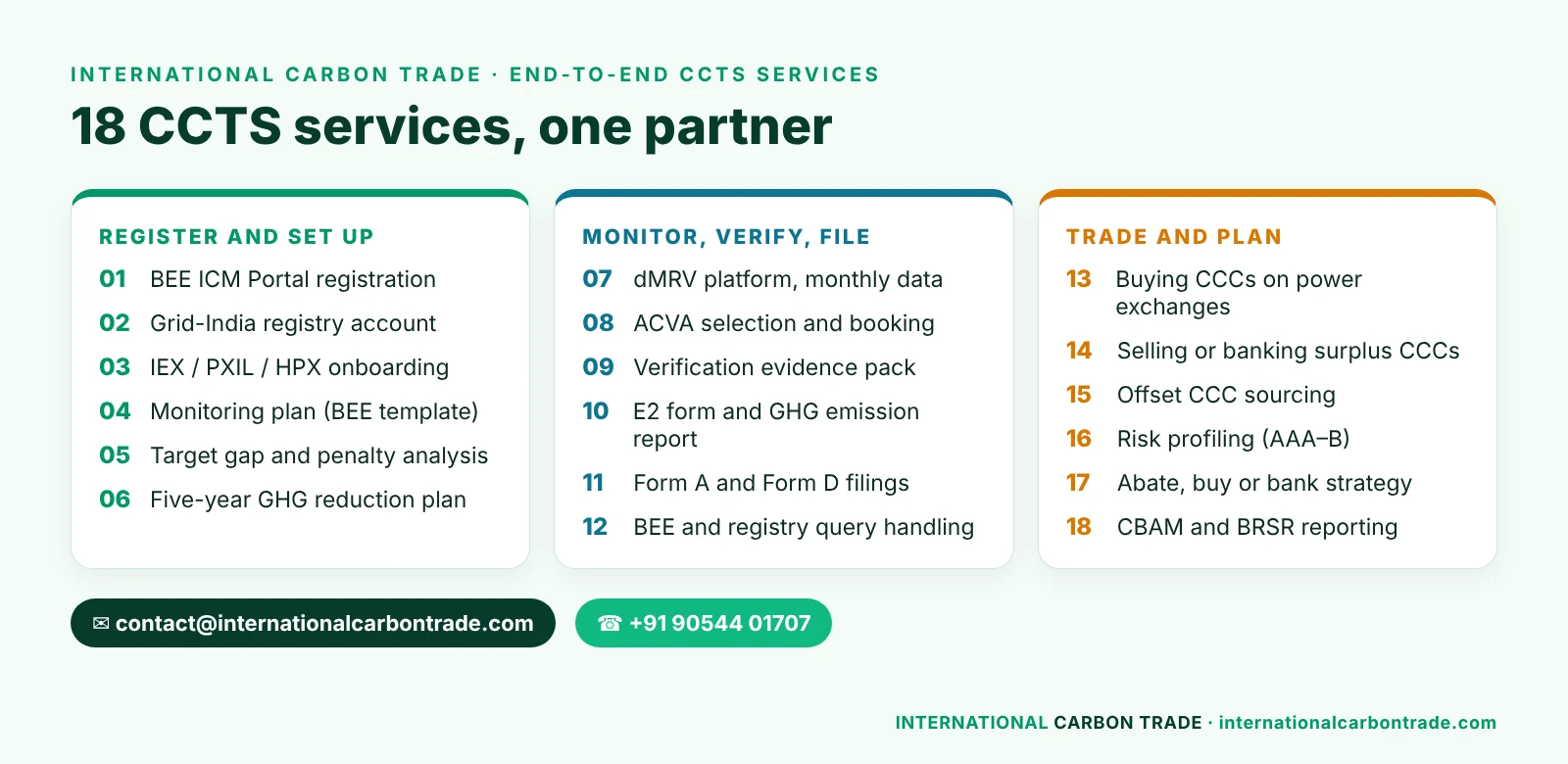
| Register and Set Up | Monitor, Verify, File | Trade and Plan |
|---|---|---|
| BEE ICM Portal registration | dMRV platform, monthly data | Buying CCCs on power exchanges |
| Grid-India registry account | ACVA selection and booking | Selling or banking surplus CCCs |
| IEX / PXIL / HPX onboarding | Verification evidence pack | Offset CCC sourcing |
| Monitoring plan (BEE template) | E2 form and GHG emission report | Risk profiling (AAA–B) |
| Target gap and penalty analysis | Form A and Form D filings | Abate, buy or bank strategy |
| Five-year GHG reduction plan | BEE and registry query handling | CBAM and BRSR reporting |
For any services related to CCTS, contact International Carbon Trade:
- Email: contact@internationalcarbontrade.com
- Phone: +91 90544 01707
- Website: internationalcarbontrade.com
- LinkedIn: Follow International Carbon Trade
Frequently Asked Questions
- Is a site visit mandatory?
- Yes. The procedure requires the verifier to make at least one site visit during verification.
- What is the difference between Form A and Form B?
- Form A is the plant's performance assessment document. Form B is the ACVA's certificate of verification, filed together with Form A.
- What is check verification?
- A second, independent review ordered by BEE and carried out by a different ACVA. The result is certified in Form C.
- How long after Form A are CCCs issued?
- On the procedure's timelines, about three months: two months for BEE, two weeks for the NSCICM, then Central Government approval and two weeks for issuance.
- How can ICT help with verification?
- International Carbon Trade prepares verification-ready data, matches you with sector-accredited ACVAs and builds the evidence pack. Contact contact@internationalcarbontrade.com or +91 90544 01707.