Abate or Buy Carbon Credits? The CCTS Cost Curve Explained
Should a CCTS plant cut emissions itself or buy carbon credits? How a marginal abatement cost curve answers it, and why year two costs more.
Every plant with a CCTS target faces one question: is it cheaper to cut a tonne ourselves, or to buy a Carbon Credit Certificate? The tool for answering it is a marginal abatement cost curve (MACC).
How to Read a Cost Curve
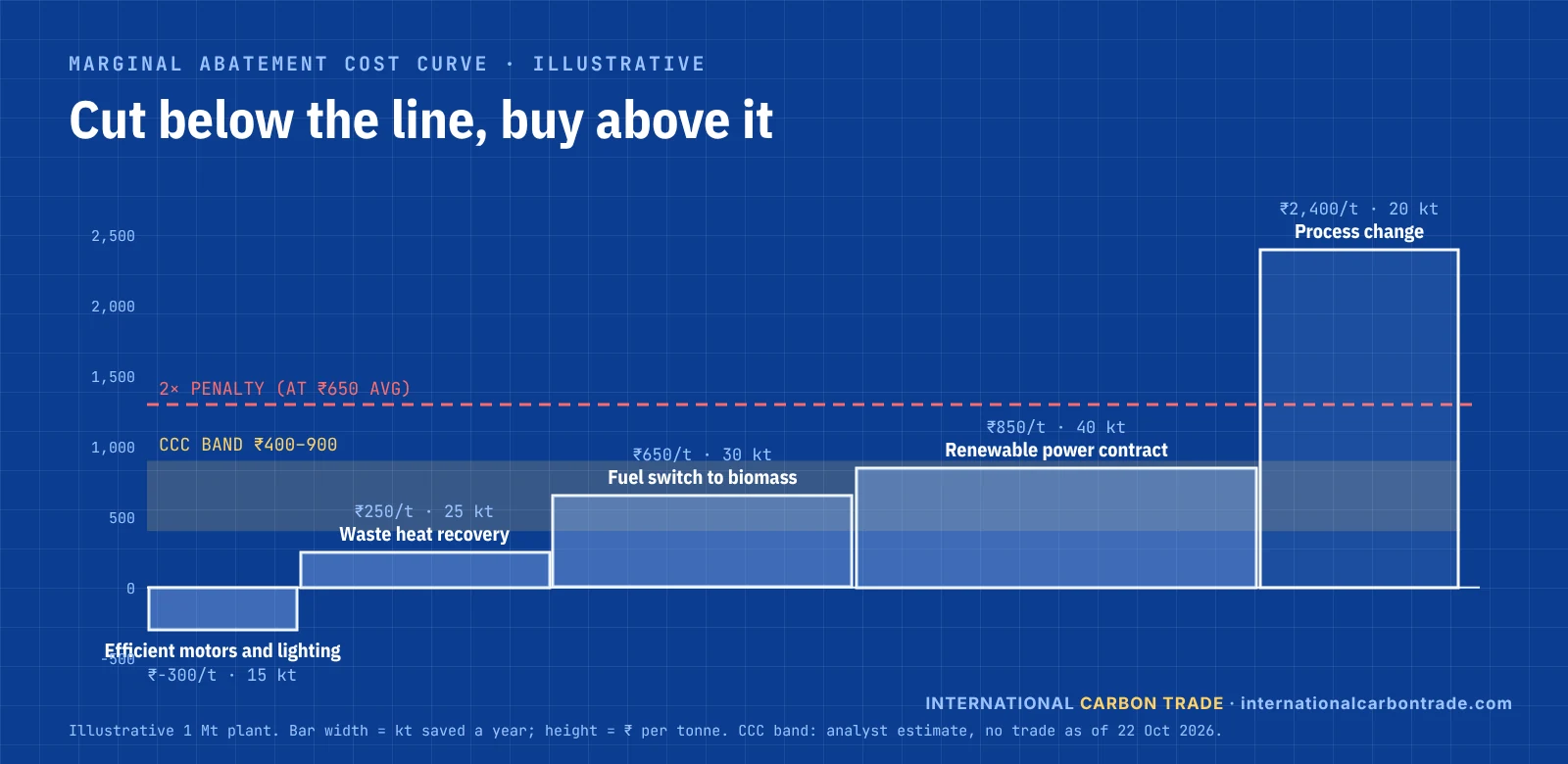
Each bar is one lever: its width is the tonnes it saves a year, its height the cost per tonne. Read from the left: cut every tonne that costs less than the CCC price, and buy the rest. Missing altogether costs 2× the average CCC price in environmental compensation, so that line marks the cost of doing nothing.
The curve above is illustrative. Your plant's curve depends on its process, fuel and capital.
Why Year Two Costs More
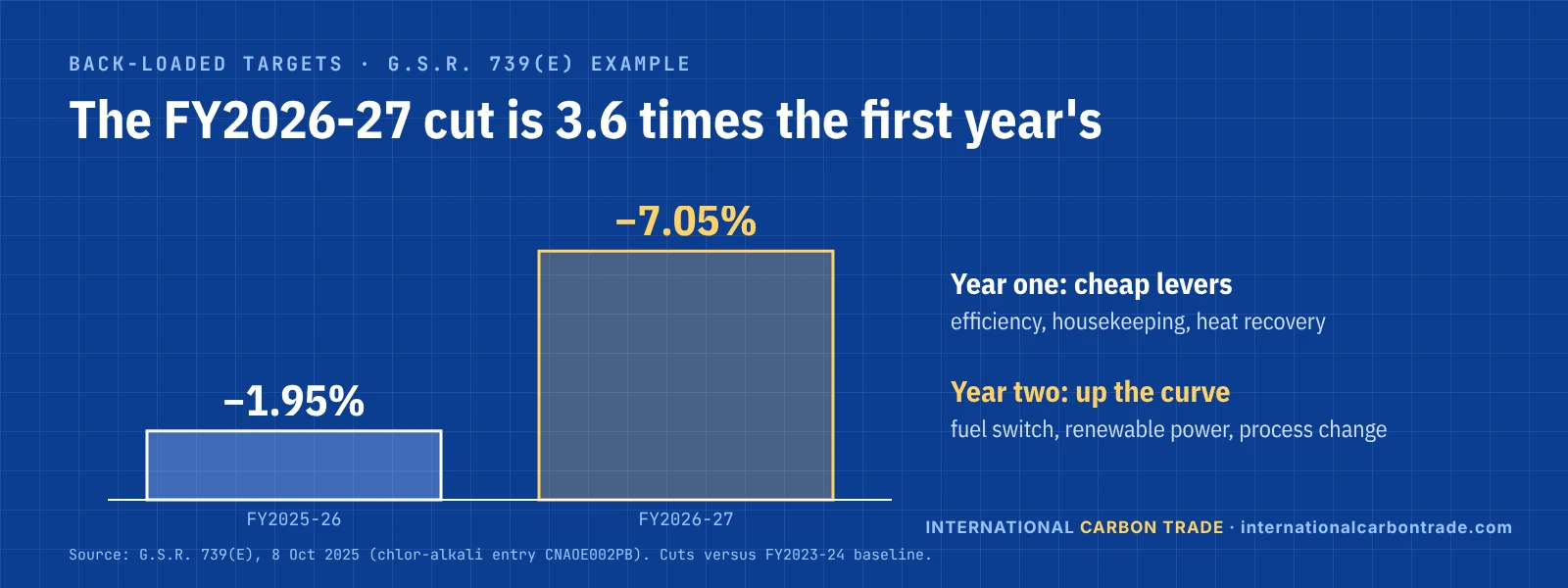
Targets are back-loaded. In one chlor-alkali example from G.S.R. 739(E), the cut is 1.95% in FY2025-26 and 7.05% by FY2026-27. The cheap levers get used in year one, so year two moves you up the curve, where each tonne costs more. Analysts put typical efficiency and fuel-switch costs around ₹400–800 per tonne, right inside the expected ₹400–900 opening CCC range.
The Decision Grid
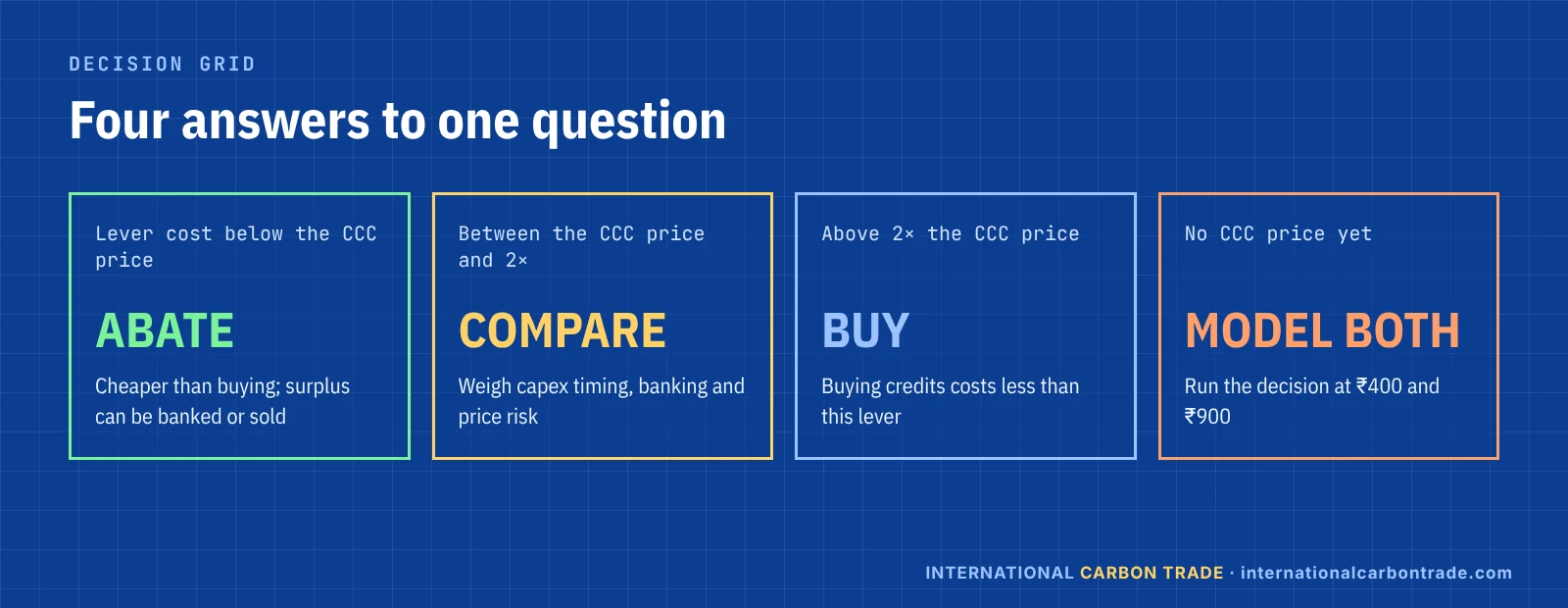
As of 22 October 2026, no CCC has traded, so the buy side of the comparison is still an estimate (what still has to happen). Surplus from cheap abatement can be banked or sold, so over-achieving isn't wasted.
ICT builds your abate, buy or bank plan: we cost each lever from your dMRV data and compare it with the CCC price band every month.
Free abate-or-buy snapshot: email your Gazette code and top three planned projects to contact@internationalcarbontrade.com.
Keep Reading
- Is CCTS Cap and Trade? Intensity Targets, Zero Credits, Banking
- Cement Carbon Credits: Will India's Cement Plants Buy or Sell?
- India's First Carbon Credit Trade: What Still Has to Happen
Our CCTS Services
International Carbon Trade (ICT) is an India-based CCTS marketplace and dMRV platform offering 18 end-to-end services, from BEE ICM Portal registration and ACVA verification to buying, selling and banking CCCs on India's power exchanges.
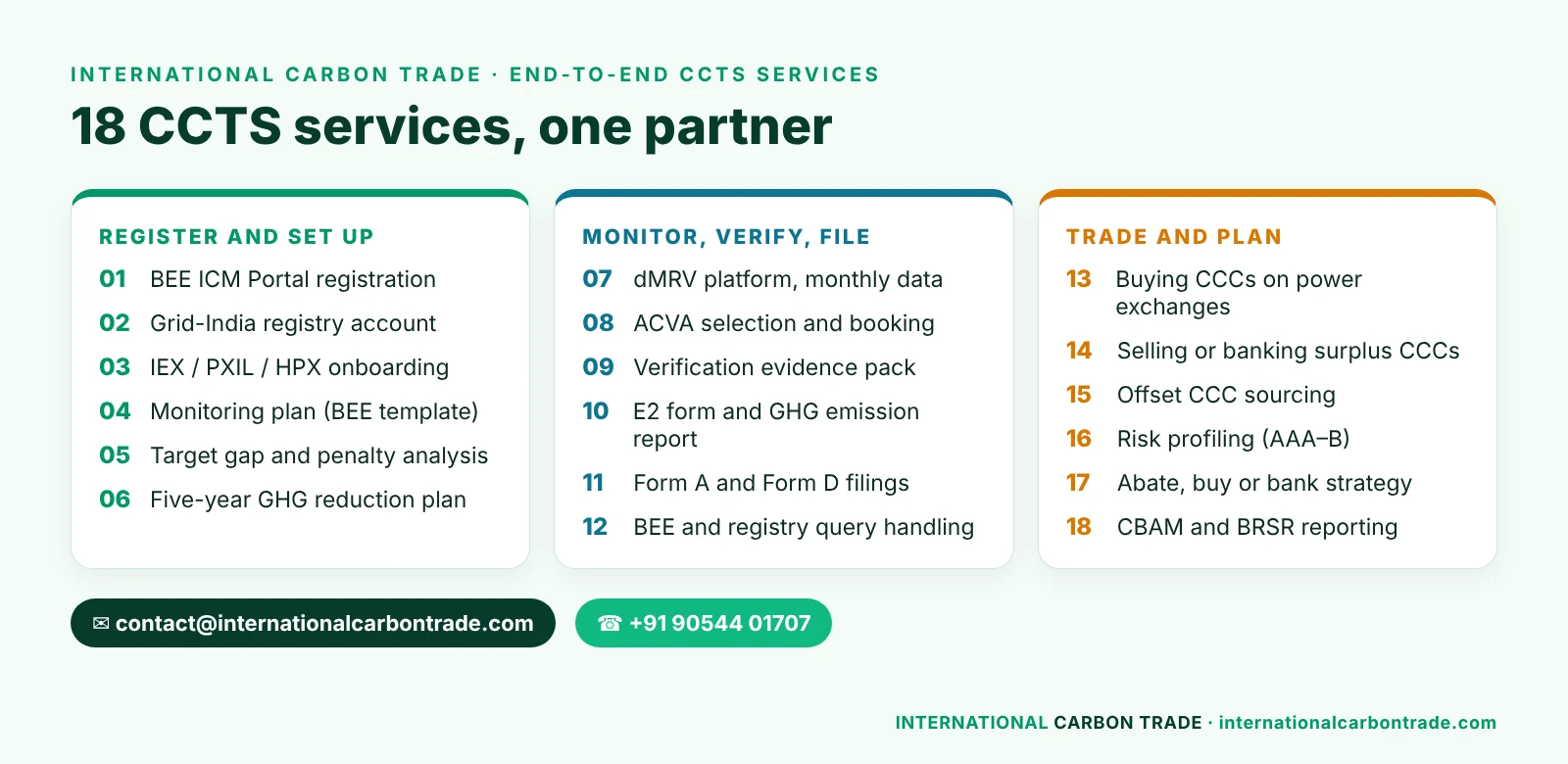
| Register and Set Up | Monitor, Verify, File | Trade and Plan |
|---|---|---|
| BEE ICM Portal registration | dMRV platform, monthly data | Buying CCCs on power exchanges |
| Grid-India registry account | ACVA selection and booking | Selling or banking surplus CCCs |
| IEX / PXIL / HPX onboarding | Verification evidence pack | Offset CCC sourcing |
| Monitoring plan (BEE template) | E2 form and GHG emission report | Risk profiling (AAA–B) |
| Target gap and penalty analysis | Form A and Form D filings | Abate, buy or bank strategy |
| Five-year GHG reduction plan | BEE and registry query handling | CBAM and BRSR reporting |
For any services related to CCTS, contact International Carbon Trade:
- Email: contact@internationalcarbontrade.com
- Phone: +91 90544 01707
- Website: internationalcarbontrade.com
- LinkedIn: Follow International Carbon Trade
Frequently Asked Questions
- What is a marginal abatement cost curve?
- A chart that ranks emission-cutting options by cost per tonne, with each bar's width showing the tonnes it saves.
- Should a CCTS plant abate or buy carbon credits?
- Cut every tonne that costs less than the expected CCC price and buy the rest, while checking timing, capital and banking.
- What is the expected carbon credit price in India?
- Analysts expect an opening range of about Rs 400 to Rs 900 per tonne. As of 22 October 2026, no CCC has traded.
- Why is the second CCTS year harder?
- Targets are back-loaded. In one Gazette example the cut rises from 1.95% in FY2025-26 to 7.05% in FY2026-27, after the cheapest levers are used.
- Can surplus CCCs be kept?
- Yes. CCCs can be banked for future compliance years or sold on IEX, PXIL or HPX.
- How can ICT help with abate-or-buy decisions?
- International Carbon Trade costs abatement levers from dMRV data and builds abate, buy or bank plans. Contact contact@internationalcarbontrade.com or +91 90544 01707.